by Lucy | May 18, 2018 | Motivational Mondays
Kara showed up in my office feeling frustrated and confused, she exclaims “just when I think I’m doing well and finally losing weight, I step on the scale and see the same number for the third month in a row!“ Kara previously lost weight by eliminating most carbohydrates – motivated to look fabulous in her wedding dress – dropped 30+ lbs only to regain the weight and more. This time, Kara is taking a different approach by eating well-balanced and including 5 workouts each week. She discovered a unique gym near home that provides guided exercise with the statistical feedback through her Fitbit and heart rate monitor, which helped increase her motivation and engagement. However, she has found the process is much slower this time around.
Kara’s story is not uncommon and may sound familiar to some of you. During our conversation, Kara explains she hasn’t been to the doctor for years and worries her weight may have a negative impact on her health. She asked frankly, “can you be healthy and still carry extra weight at the same time?” The short answer, YES.
When you go to the doctor, the nurse checks your weight, height, blood pressure, temperature, pulse, etc. Often, the doctor orders lab test to get additional information about your overall health and well-being. If you were to go to the doctor and they simply checked your weight, then the doctor comes in and prescribes diabetes medications, I imagine you would be suspicious and skeptical about this diagnosis. Our body mass index – BMI – is simply one clinical indicator of health. This number does not take into account your muscle mass, bone density, or genetic background, all of which have significant impact on your health.
At Well Balanced Nutrition, we believe in health at every size. This is not a free pass to go eat a dozen donuts and sit on the sofa all weekend! Health is sum of your lifestyle, diet, and behavior choices. Checking your weight regularly, whether that means every day, once a week, or once a month is one way to track your progress. However, there are many other means of tracking.
How do you know you’re on track?
- How do your clothes fit? Have you found yourself exclusively reaching for the yoga pants, elastic waist, and loose-fitting clothes? That might be a sign that it’s time to pay closer attention to what you are eating and/or drinking. Prior to starting a workout program, you can also take measurements around your arms, waist, hips, and thighs. That way, in case you gain muscle and do not lose weight, you will likely still lose inches.
- What are you eating? I know firsthand, how someone has eaten for the last 3 days is how they have “always eaten.“ We humans have terrible memories for the details of what we consumed lately unless there is some means of tracking. That might be an app, paper food journal, or picture journal.
- How is your mood? Personally, when I don’t eat well, get insufficient sleep, or less physical activity I feel awful. I’m a little extra irritable, moody, and generally less fun to be around – just ask my boyfriend! Pay attention to your mood and ask yourself “WHY am I feeling the way I feel?” Has something in your routine changed?
- How are you sleeping? Sleep is directly impacted by our day-to-day choices. Some people notice they sleep poorly if they eat simple carbohydrates, especially refined sugar, after 7 PM. Others report sleeping poorly if they have too much alcohol to drink or not enough water.
- What is your energy level? It could be low due to an extra stressful week, catching up from vacation, or having a sick child at home. Our energy level is all highly impacted by what we eat and how we spend our free time.
Food for thought:
If health is not determined by our weight, why do we keep letting that darn number on the scale tell us about our self-worth and well being? You are more than a number! What other means of tracking helps you know you are Well Balanced?

by Lucy | May 3, 2018 | Nutrition Questions Answered, Well Balanced Wisdom
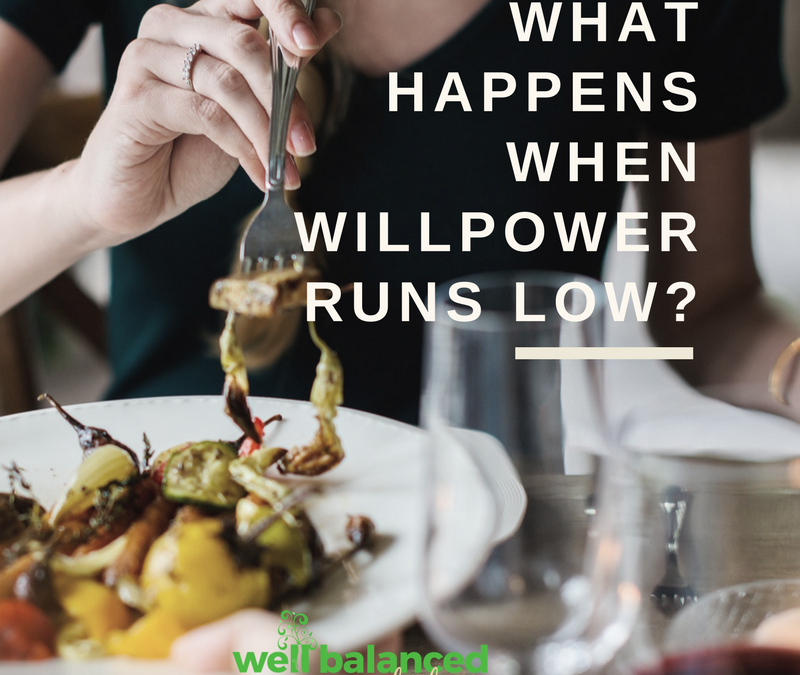
Before going out to for Italian food with friends, Lisa thought she would order the baked chicken parmesan with a salad. Once at the restaurant, hungry and exhausted from an overwhelming workweek, she ordered the ooey gooey cheesy lasagna and ate it all. Then, Lisa woke up the next morning two pounds heavier and feeling shame and guilt wash over her. If you found yourself relying on willpower to make your healthy food choices you may have had a similar experience. This often comes from a diet mentality. It’s the thought pattern ‘as long as I can be good I will be able to [fill in the blank],’ that leads us to drain the willpower tank because we overthink every decision and default into old habits.
At the beginning of each day, most of us wake up feeling confident and determined “today’s the day, I’m going to be healthy!” As we go throughout the day making thousands of decisions and using our mental and physical energy, our tank may get depleted. That is when you find yourself craving something crunchy, salty or sweet around 3 PM (or if you’re like me it’s at 9 PM). Either way, we know willpower is not the solution to living a healthy Well-Balanced life.
3 steps to keep your willpower tank full
- Notice when you’re relying on willpower. Recognize that little voice in your head saying; no, I won’t eat the free bagels in the break room today. Yep, that is good old willpower going to work for you. There is some evidence that states, I won’t statements deplete our willpower more rapidly. First, notice when you are denying yourself something that your brain is craving. Kristen describes it as riding the crave wave. It is okay because most cravings pass.
- Replace ‘I won’t’ with ‘I want.’ Once you’ve noticed the I won’t, you can start to change your thoughts to include ‘I want [something better that will help me reach my goals].’ For instance, if your brain saying I won’t eat the leftover cake that someone brought to work, instead, I want my delicious egg muffins and fruit smoothie, because it gives me the energy I need to do my job. Or simply I want to eat Well-Balanced and I know those donuts will just lead me to a sugar crash and make me feel awful later.
- Create a new normal – aka automation. Research claims up to 95% of all we do is subconscious. Think about the last time you took a shower. Did you stop and think ‘Now I pour the soap. Now I wash my hair. Now I shave my legs…’ Unlikely! It just happens, right? Same goes for food. Our brains are designed to keep us alive, not help us reach our ultimate health and well-being. When the brain senses energy-dense foods, like cheese and French fries, it sends signals to keep eating in case you experience scarcity or famine. Setting up healthier habits, such as packing a sandwich with baby carrots and an orange for lunch instead of relying on whatever you can find near the office will eliminate the task of making another decision.
Food for thought:
Is a diet mentality holding you back? It is common – even socially acceptable and encouraged – to reward ourselves with a special treat. This behavior pattern may have started in childhood when our well-meaning teachers or caretakers would supply candy or snack foods for good behavior. On the road to Well Balanced, there is an important step in recognizing what habits are holding us back. We invite you to take the Diet Mentality Assessment to pinpoint where your downfalls might be sabotaging your health, weight, and wellness goals.

by Lucy | Apr 24, 2018 | Well Balanced Wisdom
I never played sports; therefore, the coaching concept is new to me. At Grace Church, pastor Kendrick recently taught us about people who struggle without improvement versus people who grow and develop in the midst of their struggles. He put it bluntly, when we are in performance mentality and seeking the approval or acceptance of others, we become prideful. A performance mentality is sometimes rooted in insecurity because the ego doesn’t like to be wrong or embarrassed. When Michael Jordan got cut from the high school varsity basketball team as a sophomore he was devastated; however, instead of throwing in the towel on his dreams he hit the courts and practiced, practiced, and practiced some more.
Some of our clients assume Kristen and I will give them a meal plan, a few recipes, and maybe a cheer to keep them on track. Instead, they get a coach – someone to listen, give feedback, and provide a toolbox of skills to live a happy and healthy lifestyle.
In order to grow and get better, here are five steps to becoming more coachable and achieve your ultimate health and well-being.
5 steps to achieve your goals
- It always starts with a vision. Sports enthusiast and professionals spend time envisioning themselves succeeding. For instance, when a golfer steps up to the tee, she will envision the ball going in the direction and landing exactly where she wants it to be. If she steps up to the ball and starts thinking about something else or looking into the sandpit, that’s where the ball goes. What is the vision of your healthiest self look like? What are your habits? How do you feel?
- Next, comes skills development. If you’ve never hit a golf ball, it’s unlikely that it will go very far or exactly in the direction you were hoping the first time you play. Instead, you start by learning which golf club to use, the appropriate grip, the right stance, and the swing. Same idea if you’re unfamiliar with how to cook and assemble Well Balanced meals. First, we need to start with what is well-balanced? Then how plan meals to meet your nutritional needs.
- Put it into action! Now we apply our new skills. On the golf course that may mean going to hit a bucket of balls at the range. For someone looking to become healthier, it could be planning a week of Well Balanced dinners for the family.
- Grow. It’s OK to fall down, it’s OK to not succeed. Each time we “fail,” is a chance to learn how not to do it next time. So what if you swung the golf club and missed the ball by inches? Sounds like the time to laugh it off and try again. And if you had cereal for dinner last night (again), perhaps it’s a good chance to stock up on a few of our favorite Quick Fix Meal ideas.
- Lastly, we need to be humble! That means if you keep trying and it’s not working it’s time to ask for help. It could be time to hire an instructor and get on the greens for guided practice or several. And if you’ve tried diet after diet with the same results we invite you to apply for a Breakthrough the Diet Mentality call.
Food for thought
Most of us have two voices that sometimes go to battle in our heads… “I got this!” and “why bother?“ That second voice is just our ego trying to protect itself. Instead, listen to the helping and encouraging thoughts – create a vision, practice the healthy habits, and get back on if you fall off the wagon. And if you need some help in the kitchen, you know where to find us: contact Lucy & Kristen.

by Lucy | Apr 17, 2018 | Well Balanced Wisdom
Have you ever thought to yourself ‘If only I had more willpower, then I could be healthy and lose weight?’ You are not alone. As nutritionists, we talk to many people who assume they are weak and lacking in willpower. That’s why they haven’t been able to stop going to Chick-fil-A after work or eat just one handful of mixed nuts instead of half the container. To boost willpower, we need to start with the understanding that willpower is an unreliable resource affected by the number of decisions we’ve made, temptations we face, and even the mood we are in.
Why willpower runs out:
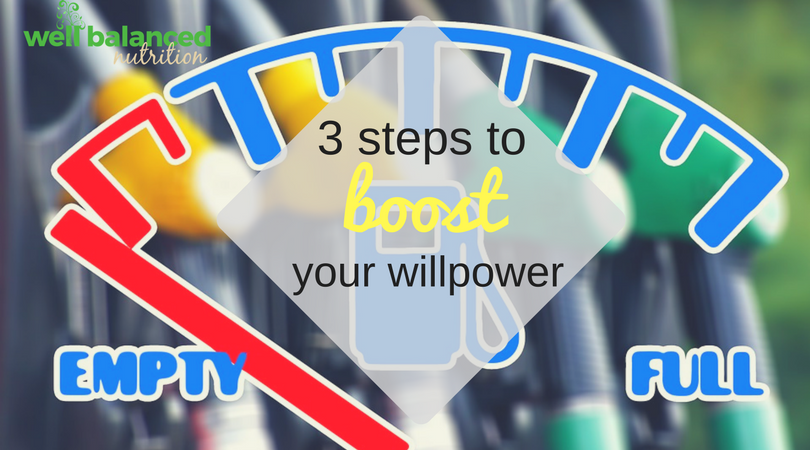
Willpower can easily be overused and depleted if we aren’t careful. Think of willpower as a gas tank in a car. Maintaining steady blood-sugar levels by eating well-balanced meals and snacks regularly (aka keeping it full of quality fuel), keeps our willpower levels high. Also setting up healthier environments and habits can help us rely less on willpower and more on cruise control. Without steady fuel and good habits in place, we can quickly burn through our “tank of willpower” before noon.
For instance, if someone arrives to work without eating breakfast and finds themselves at a meeting with free biscuits, they are more likely to grab the free food. On the flip side, another coworker who routinely eats a Well-Balanced breakfast consisting of an egg sandwich and an apple is less likely to feel tempted by the same biscuits.
How to boost your willpower:
Keep your willpower tank full by saving your willpower for emergencies, rather than everyday moments. The 3 steps to keeping your tank full are:
- Setting up cruise control: creating healthy attainable habits and not relying on willpower alone to achieve your goals.
- Selecting high-quality fuel: including a positive self-image and attitude, as well as, incorporating proper nutrition at regular meals.
- Avoiding rough roads: avoiding temptation when possible and putting strategies in place that help you manage the situation when temptation might arise.
Food for thought:
Sometimes willpower is the tool you need in the moment. More often, we need to find other ways to make healthy choices. Are you relying too much on willpower? Take this quiz to find out where you stand with willpower and get additional strategies for making the healthier choice more often.

For additional support and personalized wellness plans, please contact us 🙂
by Lucy | Mar 25, 2018 | Meal Planning, Well Balanced Wisdom
Meal planning and prepping take effort, skill and time, which makes it a bit challenging. The good news is that strategies and solutions exist to suit everyone’s needs. Let’s dive into your tendencies and your situation and how you could leverage them to your advantage. Below I make suggestions based on your tendency. If you don’t know what your tendency is, please read this blog post first.
Upholders – Since upholders readily meet expectations and get things done, they would do well with a meal planning service. Everything from the recipes to the grocery lists is done for you which can save you a lot of time. There are many options and a few of my favorites include Super Healthy Kids Meal Plans (done by registered dietitians and family friendly), My Happy Plates (a local company, includes grocery delivery service), No More to Go (has 3 options: cooking-for-2, gluten-free and family).
Obligers readily meet outer expectations that others impose but struggle to meet the inner expectations they want to impose on themselves. Therefore, they must find creative ways to set up some external accountability. Meal prepping partners or groups can keep obligers motivated and can be a ton of fun. Who wouldn’t enjoy cooking with your friends or neighbors and drinking wine while prepping your meals? Your group can meet weekly like in this plan or you can select a few freezer meals that can be pulled out at any time. Here is a great done-for-you meal prep party plan that includes recipes and all.
Furthermore, obligers tend to be motivated to do things that benefit others. These ideas could help:
- Have a reoccurring dinner date with a friend where you take turns cooking.
- Commit to bringing a home cooked meal to a neighbor or friend. Double the recipe so you can eat it too.
- View the responsibility of meal planning and prepping as something important you want to role model for your children.
- Make a pact with your bestie that you can’t do X until you’ve meal planned and prepped for the week and ask them to hold you to your word.
Questioners like to do the research, decide for themselves, customize things to fit their needs and act with good reason. Questioners will do well if they’ve already made their mind up to meal plan and prep. If they haven’t, they might need to explore why meal planning is important to them. Done-for-you meal planning services could work well, but it is likely questioners will want to customize it to their style and preferences. They will only stick to it if the plan is logical and efficient, which could simply take a little trial, error, and tweaking to suit their needs.
Rebels – do best when they take it one day at a time. They may want to keep a stocked kitchen and have several meal ideas that can be thrown together in a pinch. Having a loose plan, such as 3-4 meal ideas for the week is better than having a specific dinner for a specific day of the week (which could also be true for some questioners and obligers).
Hate to cook? – Clean-eatz is perfect for those who just want someone to cook for them. Another idea is to trade services with their friends that do enjoy to cook. For instance, a mom of young kids who likes to be in the kitchen but doesn’t have the distraction-free time to do so could pair up with a mom who hates to cook but would love to play with the kids.
Cooking for one? Cereal for dinner again? You can do better! It’s really easy to slack off at dinner time when you only have your own mouth to feed. Using the above strategies like inviting a friend, cooking for someone else or having a meal prep party might work well for you.
Hate leftovers? When cooking for one, finding the right recipes is important. You probably get turned off by most recipes you see because you’d be eating the same thing for DAYS. I really love this roundup of healthy single-serving meals and I think you will, too.
Food for thought:
There is no one-size-fits-all approach to meal planning and prepping, but it’s an important part of healthy eating. Without at least a little forethought, you’ll be eating cereal or fast food most nights. Thinking about your unique style, situation and needs can help you find the strategies that work. This will take some trial and error. The important thing is that you keep making an effort to choose nourishing foods that meet your health goals. It doesn’t have to be perfect and it may look different each week, but what matters is that you are putting in the effort continuously. That’s when you finally find your groove. Just don’t give up.