The other morning I was reading a great book by Kate Northrup titled Money: A Love Story. This is not your typical financial planning book. Instead, it’s an opportunity to take a mindful journey to understand and develop a healthier relationship with money. Northrup goes on to explain there are a lot of feelings and emotions around money and anybody that says otherwise is not being truthful with themselves.
Kristen and I would venture to say the same thing about food. When somebody is having issues making a change their diet, I have to tell them it’s rarely about the food. For instance, if you find yourself craving comfort foods, we may suggest that you are in need of more connection and/or love (or a good nights sleep!). We tend to seek comfort in the form of food if we feel isolated, disappointment, sad, overwhelmed, etc. Other healthier coping tools would include volunteering, calling a friend, playing with your furry or not-so-furry child or taking a walk.
As I continued reading and journaling, as prompted by Northrup, I suddenly had the urge to check my bank account. That is when I realized all the money for rent was still sitting in the bank account, which means I was at least two days late paying our rent. *palm to the face* Luckily, I was in full fledge observation mode and just started journaling my thoughts in that very moment. Do you know what I’ve discovered? I am a jerk face to myself! I was instantly telling myself that I’m an idiot and I should know better. So it was demoralizing and unproductive.
As a person who fancies herself as self-aware, it was incredibly surprising to have this bombardment of negative self talk flood my mind. Soon there were tears and I felt even more ridiculous for crying over $50. Seriously.
Fast forward to a few hours later and I’m walking through the woods.… Catching cobwebs. It got me thinking that these negative thought patterns are kind of like cobwebs in our minds. We’ve built them in without even realizing that they are making this journey to happy and healthy a lot less pleasant.
The first step
Today I’m encouraging each of you to just notice when you have a negative thought run through your mind. Anything such as, “you idiot!” Or “you should have…” Or “you know better. Why do you keep making the same mistake?!”
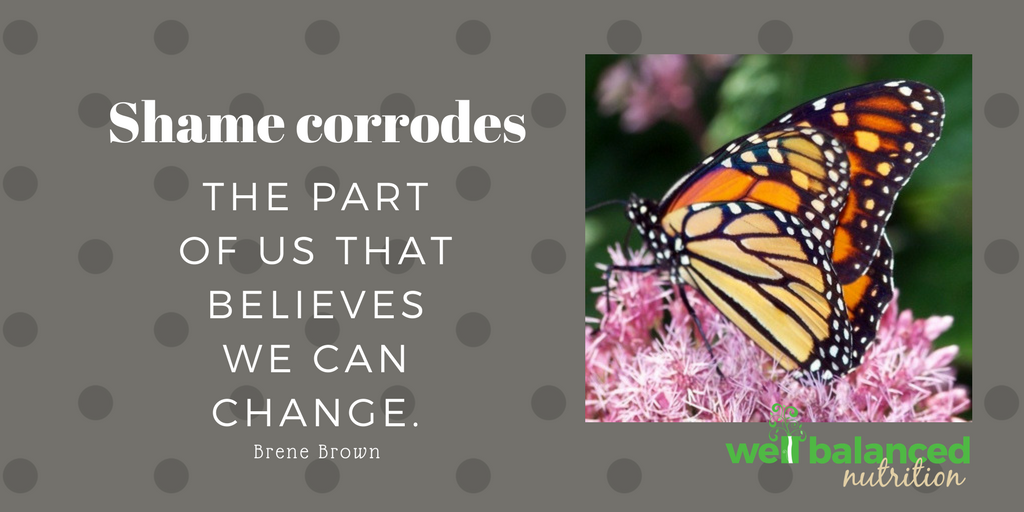
We now know that this is self shaming and as Brene Brown reminds us shame corrodes the part of the brain that believes that we can change. In short, shame does not help you do better. In fact, it will probably perpetuate the same negative behaviors. When we notice the negative thought patterns we can start to change them. I often teach friends and clients to try Cancel. Cancel. Cancel. when they first notice the negativity. Then create a helpful mantra or affirmation to replace the thoughts. Sometimes it can be as simple as repeating “release.” Or as Northrup mentions in her book, “I am pure, calm grace.” Important note: the affirmation needs to resonate with you. That means when you find an uplifting quote or phrase make sure it is speaking your truth. Do you believe and embody it?
Food for thought:
It always seems easier to help others recognize these negative thought patterns. Do you have a friend or loved one that you trust that could help you see where you might be allowing these negative thought patterns and cobwebs of the mind to hold you back?
Kristen and I are happy to help you clear the way and make a more enjoyable journey into your happy and healthy – let us know how we can help?
Should I follow the “keto” diet?
Lucy and I have been asked this question a lot lately. The answer is (drumroll please)… it depends. Read on to find out the facts, determine if it’s right for you and see what we recommend.
Ketogenic Diet Explained
Let’s start by answering the question, WHAT IS THE KETOGENIC DIET? It’s a diet consisting of a meager amount of energy from carbohydrates (5-10% or no more than 50 grams per day), a moderate amount of energy from protein and a high amount from fat. The goal is to let your body “burn off” all its carbohydrate stores and switch its fuel source to fat (which our bodies turn into ketones).
A healthy ketogenic diet will include many nutrient-dense vegetables like green-leafy vegetables, bell peppers, cabbage, broccoli, cauliflower, asparagus, green beans and Brussel sprouts. Protein needs are met with quality meat and seafood, nuts. cheese, and eggs. Lastly, “good fats” are added to meals or used in cooking such as coconut oil, butter, cream, and olive or avocado oil.
A day of following the ketogenic plan would look like this.
- Breakfast: Two scrambled eggs made with heavy cream and cooked leafy-greens. Coffee with butter or coconut oil.
- Lunch: Tuna salad (tuna + full-fat mayo + chopped celery) over a bed of romaine lettuce + green bell pepper slices + cherry tomatoes + one-half an avocado.
- Dinner: Pecan crusted salmon with cauliflower rice + asparagus + 6 raspberries
Why is the ketogenic diet such a hot topic right now?
It has been known for quite some time to be an effective treatment for epilepsy. More recent studies are producing positive outcomes in neurological diseases like Alzheimer’s and Parkinson’s. Other studies have looked at its potential effect on cancer with great preliminary findings that the diet could help achieve remission. Lastly, in a 12-month trial, adults with elevated HbA1c (associated with diabetes) and body weight assigned to a keto diet had greater reductions in HbA1c, lost more weight, and reduced more medications than those instructed to follow a low-fat, moderate-carbohydrate diet. All fascinating findings, but we still need to learn more.
How does the keto diet cause rapid weight loss?
First of all, the diet eliminates several food groups from your diet drastically cutting back your calorie intake. Secondly, as you limit your intake of carbohydrates, your body produces less insulin and begins to utilize all the sugars that are stored away in your muscles and liver for energy. The breakdown of the stored energy causes the kidneys to flush out water (and along with it, electrolytes your body needs like magnesium, calcium, sodium, and potassium). This loss of water is part of the reason people see dramatic scale drops in the first few weeks of eating a ketogenic diet. It’s also why weight can be regained quickly.
So, is the keto diet right for you if you just want to lose weight and feel awesome?
Let’s look at the reality of it. It’s definitely not a magic bullet because there are downsides to this extreme approach. It’s a significant lifestyle shift. Yes, you might lose weight quickly (in the beginning much of it is water weight), but if you can’t stick with it, chances are it could do more harm than good. While you may read several success stories on the internet, what you don’t see are the cases in which more weight is regained than was initially lost once they came off the diet. Just because it works for some, doesn’t mean that it’s the best diet for you.
The best diet for you is one you can stick to for life.
It may seem obvious, but even the research indicates that the ketogenic diet is hard to follow for an extended amount of time. Some of the research studies had drop-out rates as high as 50-84%. If you are a long-time reader, you know we promote taking small, manageable steps rather than leaping into a brand new lifestyle.
It might affect your social well-being.
Social connections are vital to your health. If following the ketogenic diet will isolate you from your loved ones or your friends, you are putting your health and happiness on the line. Will you be able to share meals with loved ones? Can you still enjoy life’s unique and sporadic moments? This is a serious question to ask yourself before you consider starting the ketogenic diet.
The bottom line:
We recommend taking a look at your current diet and finding some small baby steps you can take and build upon those, rather than changing everything drastically all at once. For instance, cut out sugary drinks and fast food or increase fiber intake with more vegetables at your meals. If you decide the ketogenic diet is one you can follow for years to come, be sure to work with a registered dietitian in order to help you meet your nutrition needs and focus on high-quality, nutrient-dense food choices.
Kara showed up in my office feeling frustrated and confused, she exclaims “just when I think I’m doing well and finally losing weight, I step on the scale and see the same number for the third month in a row!“ Kara previously lost weight by eliminating most carbohydrates – motivated to look fabulous in her wedding dress – dropped 30+ lbs only to regain the weight and more. This time, Kara is taking a different approach by eating well-balanced and including 5 workouts each week. She discovered a unique gym near home that provides guided exercise with the statistical feedback through her Fitbit and heart rate monitor, which helped increase her motivation and engagement. However, she has found the process is much slower this time around.
Kara’s story is not uncommon and may sound familiar to some of you. During our conversation, Kara explains she hasn’t been to the doctor for years and worries her weight may have a negative impact on her health. She asked frankly, “can you be healthy and still carry extra weight at the same time?” The short answer, YES.
When you go to the doctor, the nurse checks your weight, height, blood pressure, temperature, pulse, etc. Often, the doctor orders lab test to get additional information about your overall health and well-being. If you were to go to the doctor and they simply checked your weight, then the doctor comes in and prescribes diabetes medications, I imagine you would be suspicious and skeptical about this diagnosis. Our body mass index – BMI – is simply one clinical indicator of health. This number does not take into account your muscle mass, bone density, or genetic background, all of which have significant impact on your health.
At Well Balanced Nutrition, we believe in health at every size. This is not a free pass to go eat a dozen donuts and sit on the sofa all weekend! Health is sum of your lifestyle, diet, and behavior choices. Checking your weight regularly, whether that means every day, once a week, or once a month is one way to track your progress. However, there are many other means of tracking.
How do you know you’re on track?
- How do your clothes fit? Have you found yourself exclusively reaching for the yoga pants, elastic waist, and loose-fitting clothes? That might be a sign that it’s time to pay closer attention to what you are eating and/or drinking. Prior to starting a workout program, you can also take measurements around your arms, waist, hips, and thighs. That way, in case you gain muscle and do not lose weight, you will likely still lose inches.
- What are you eating? I know firsthand, how someone has eaten for the last 3 days is how they have “always eaten.“ We humans have terrible memories for the details of what we consumed lately unless there is some means of tracking. That might be an app, paper food journal, or picture journal.
- How is your mood? Personally, when I don’t eat well, get insufficient sleep, or less physical activity I feel awful. I’m a little extra irritable, moody, and generally less fun to be around – just ask my boyfriend! Pay attention to your mood and ask yourself “WHY am I feeling the way I feel?” Has something in your routine changed?
- How are you sleeping? Sleep is directly impacted by our day-to-day choices. Some people notice they sleep poorly if they eat simple carbohydrates, especially refined sugar, after 7 PM. Others report sleeping poorly if they have too much alcohol to drink or not enough water.
- What is your energy level? It could be low due to an extra stressful week, catching up from vacation, or having a sick child at home. Our energy level is all highly impacted by what we eat and how we spend our free time.
Food for thought:
If health is not determined by our weight, why do we keep letting that darn number on the scale tell us about our self-worth and well being? You are more than a number! What other means of tracking helps you know you are Well Balanced?

Before going out to for Italian food with friends, Lisa thought she would order the baked chicken parmesan with a salad. Once at the restaurant, hungry and exhausted from an overwhelming workweek, she ordered the ooey gooey cheesy lasagna and ate it all. Then, Lisa woke up the next morning two pounds heavier and feeling shame and guilt wash over her. If you found yourself relying on willpower to make your healthy food choices you may have had a similar experience. This often comes from a diet mentality. It’s the thought pattern ‘as long as I can be good I will be able to [fill in the blank],’ that leads us to drain the willpower tank because we overthink every decision and default into old habits.
At the beginning of each day, most of us wake up feeling confident and determined “today’s the day, I’m going to be healthy!” As we go throughout the day making thousands of decisions and using our mental and physical energy, our tank may get depleted. That is when you find yourself craving something crunchy, salty or sweet around 3 PM (or if you’re like me it’s at 9 PM). Either way, we know willpower is not the solution to living a healthy Well-Balanced life.
3 steps to keep your willpower tank full
- Notice when you’re relying on willpower. Recognize that little voice in your head saying; no, I won’t eat the free bagels in the break room today. Yep, that is good old willpower going to work for you. There is some evidence that states, I won’t statements deplete our willpower more rapidly. First, notice when you are denying yourself something that your brain is craving. Kristen describes it as riding the crave wave. It is okay because most cravings pass.
- Replace ‘I won’t’ with ‘I want.’ Once you’ve noticed the I won’t, you can start to change your thoughts to include ‘I want [something better that will help me reach my goals].’ For instance, if your brain saying I won’t eat the leftover cake that someone brought to work, instead, I want my delicious egg muffins and fruit smoothie, because it gives me the energy I need to do my job. Or simply I want to eat Well-Balanced and I know those donuts will just lead me to a sugar crash and make me feel awful later.
- Create a new normal – aka automation. Research claims up to 95% of all we do is subconscious. Think about the last time you took a shower. Did you stop and think ‘Now I pour the soap. Now I wash my hair. Now I shave my legs…’ Unlikely! It just happens, right? Same goes for food. Our brains are designed to keep us alive, not help us reach our ultimate health and well-being. When the brain senses energy-dense foods, like cheese and French fries, it sends signals to keep eating in case you experience scarcity or famine. Setting up healthier habits, such as packing a sandwich with baby carrots and an orange for lunch instead of relying on whatever you can find near the office will eliminate the task of making another decision.
Food for thought:
Is a diet mentality holding you back? It is common – even socially acceptable and encouraged – to reward ourselves with a special treat. This behavior pattern may have started in childhood when our well-meaning teachers or caretakers would supply candy or snack foods for good behavior. On the road to Well Balanced, there is an important step in recognizing what habits are holding us back. We invite you to take the Diet Mentality Assessment to pinpoint where your downfalls might be sabotaging your health, weight, and wellness goals.