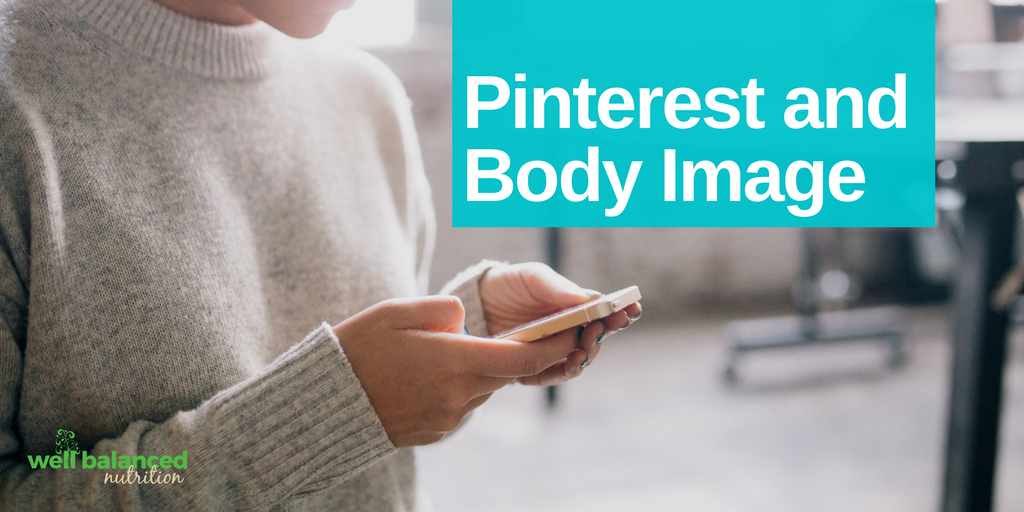
Don’t get me wrong; I love Pinterest. I think that it is a brilliant place to share creative ideas. I truly cannot imagine life without this excellent resource; however, I’ve noticed Pinterest is sometimes a trigger for body dissatisfaction. Lately, I’ve been reading The Body Image Workbook by Thomas Cash, Ph.D. I am addressing and reevaluating my body relationship and body awareness. Yes, even us skinny gals can have body image issues.
[Sidebar: I’ve decided to fast from Facebook during the Lenten season to spend that time with my creator instead of browsing mindlessly. Since I’m not banning all social media, I’ve spent a little more time on Pinterest & Instagram (@WBN_RDs)]
In this workbook, I’ve learned we all have what the author, Dr. Cash, calls Private Body Talk. In our private body talk, we have stories running through our mind – often unconsciously – about how we look. He uses the word ugly, which I truly hope none of you are calling yourselves because you are uniquely beautiful. The book goes on to explain that we each have different triggers, assumptions, and beliefs about our body image. And why wouldn’t we… What with all the perfect flat tummies and perfect booties depicted on Pinterest, Instagram, and other social media outlets. I mean seriously, who are these people with perfectly sculpted abs?! We may think “what are they eating or doing to look that way?” Or “I need to get more strict about my diet so I can have a body like that too.”
Good news, there is a tool to help.
My favorite part of the workbook is the emphasis on mindfulness. It goes into a lot of detail on increasing our mindfulness specifically around body image stories. I modified an idea in the book and created a new tool to start to notice and address these negative body image stories. It’s the TTE method:
- Thought
- Trigger
- Emotional effect
First, is noticing the body image conversation or thought. Example: you look at a photo of yourself and think “Wow, look at that fat face.” Which may spiral into a barrage of negative thoughts about other aspects of your looks you do not like. The next step is to identify the trigger. In this case, it was looking at the picture. For many, simply stepping on the scale is the beginning of a downward spiral into self-sabotaging thought patterns. Such as, “why do I even bother? I’m always gonna be fat.” The last step is recognizing the emotional effect these thoughts have on you. It does not feel good or motivational when someone calls us mean names. That usually hurts and feels shameful. How is it different for you to speak like that to yourself? We’ve shared before how words matter. Whether spoken aloud or in our minds, these have a profound impact on our behaviors and choices.
Food for thought:
I don’t actually blame Pinterest for body image concerns; however, I recognize those pictures of all the perfect airbrushed bodies can lead to negative internal chatter. That’s when I choose to log off and get centered in my own truth:
“I value feeling good. I have a healthy mind and healthy body to match.”
What are your big triggers?
What’s your truth?
You are more than a number on the scale and you matter.
If you need someone to talk about body image or to make more healthy lifestyle changes, we are here to help. Just click here to start the conversation.
Photo by Alex Woods on Unsplash
Monday, Feb 5, 2018
When we start a new project or challenge it’s easy to get swept up in the excitement of doing something new or different. Then we may hit a roadblock, get off track or just get bored and it starts to fizzle.
Were you invigorated to start a few new healthy habits in the New Year? Now you find yourself off-track and bogged down with to-do lists, chores, an illness, or just feeling tired. It happens! Life gets busy and often we are our own biggest critic.
In a recent teaching at Grace Church, in Chapel Hill, NC, I got a great reminder from the pastor to revisit the basic questions to reignite the energy and get back on the road to feeling happy and healthy.
1. What’s your why?
Why is this goal important to you? How will you feel when you’ve accomplished this goal?
2. What is true?
Maybe you did not have time to batch cook for the work week, but you did go grocery shopping and purchased the foods that make you feel better. Your inner critic may try to call that a failure, but what’s true is that you took steps toward a Well-Balanced life. Instead of thinking about what did not get done, sometimes the best thing we can do is just keep going. Step-by-step. Each better choice empowers you to do more of the same.
3. What is MY responsibility?
It’s easy to get caught up in the mom duties, covering for a sick coworker, caring for your partner, or an aging parent. First, we need to take care of ourselves before we can take care of our loved ones. When you take care of yourself first you have the energy to take care of others.
This may include learning when to say “no, thank you.” Such as declining the invite to volunteer for another fund-raiser at school or working overtime for the 3rd week in a row. When we say “yes” to everyone else we, in turn, are saying “no” to ourselves.
4. What matters most?
As Pastor Kendrick says, do first what is most important. Have you ever had a sick family member at the hospital? It is likely you found yourself making time in the evening and on weekends to visit your loved one. We make time for what is important to us. It’s okay to make time for our own health and wellness needs because they matter. It may mean blocking the 4 o’clock slot on your work calendar so you can leave by five to make it home in time to cook dinner. Or maybe you dedicate the first 5 minutes of your lunch break to meditation or prayer time.
Food for thought:
As you read this, remember you are on the road to feeling good and Well-Balanced.
You already know what you need to do to reach your goals, which step above will take you where you want to go?
If you need someone to talk about goal-setting or how to make healthy lifestyle changes, we are here to help. Just click here to start the conversation.
Have you ever really wanted to do something, like create a new habit, but try as you might you inevitably let yourself down? It’s a frustrating cycle. You want something, so you work for it but fail. Still wanting to form the habit, you try again this time with a little less confidence because of your past attempt that didn’t work out. That lack of confidence can hinder your performance, and you fail a second time. And on it goes.
What if I told you that your failure wasn’t your fault, it was your tendency?
Years ago, when I was completing my internship, I was labeled by my preceptors as a self-starter. I wanted to become a dietitian, and I knew I needed to gain approval of my preceptors to graduate from the internship. I loved learning about nutrition, and I was held accountable for my work through evaluations and deadlines. I didn’t know it then, but the fact that I had someone else evaluating was a major key to my success.
Fast forward to the present. I still love learning new things about nutrition, and I am still a “self-starter,” but finishing something is a different story. For instance, I buy a lot of books and eagerly read through the first chapter or two vowing to myself that I’m going to read a little bit each week. Inevitably, something always comes up that I do instead. Even though I want to read the book, it feels much more natural and compelling to complete the latest task my client requests or help a friend solve a problem. So, the book sits there unread for weeks, months, years even.
It wasn’t until I started a book club that I could finish a book I wanted to read.
Why can I read a book for a book club but not on my own?
Because of my tendency.
The four tendencies and how they can change the way you think about yourself.
According to Gretchen Rubin, people fall into one of four tendencies depending on how they respond to expectations – you know the things you can’t avoid, nowadays known as “adulting.”
Finding out what tendency you fall under can break you free from the cycle I mentioned above, see yourself in a different light, and help you accomplish the things you want to (or need to) do in life.
The four tendencies:
- Upholders meet inner and outer expectations. They love rules, having a clear plan and are self-motivated and disciplined. Just tell them what needs to be done, and they’ll lead the way.
- Questioners meet expectations that make sense to them. They need to see purpose and reason in anything they do. If you make it clear why something is important, chances are they will get it done.
- Obligers meet other peoples’ expectations easily but struggle with inner expectations. The must be held accountable by a friend, coach or boss to get things done. They thrive when they have a sense of duty and can work in a team.
- Rebels defy both outer and inner expectations. Above all, they want to be free to choose and express their individuality. The best way to motivate them is to give them the facts, present the task as a challenge and let them decide without pressure.
Perhaps you can quickly identify yourself in one of these categories. You may also want to take the quiz to find out for sure.
When you know your tendency, you can see yourself in a new, more positive way.
After finding out that I will always gravitate toward meeting outer expectations (like from my internship director and preceptors that were grading me), I suddenly knew how to succeed and why meeting the needs of my clients and friends is so easy for me to do. I stopped blaming myself for being lazy or unmotivated. I stopped feeling like such a failure because I couldn’t achieve my goals. Knowledge is power, and now that I know I’m an obliger, I can set up external accountability (like a book club) to follow through with the things I set out to do.
Food for thought. Tell us in the comments below:
Have you been beating yourself up over something that you couldn’t accomplish?
What will YOU do differently now that you know about your tendency?
Homework:
If you haven’t read the Four Tendencies or Better Than Before by Gretchen Rubin, we highly recommend that you do. Lucy and I have been so enlightened by these books that we’ve thoroughly woven Rubin’s concepts into the way we teach and think about well-balanced living.
Monday, January 22, 2018
Ever catch yourself thinking “oh I shouldn’t…” or I just can’t have one [insert food with no brakes]. Yep, we’ve all been there. It varies depending on a person’s taste preference and often what they grew up eating. A few I hear commonly include, potato chips, cashews, ice cream, cheese, or bite-sized Oreos. No matter what, there are certain foods that are just harder to eat in moderation.
Last year, Kristen and I read a great book called
Better Than Before by Gretchen Rubin in our book club. The book is all about making better habits. In an article, by Rubin, she talks about the concept modernization and abstinence. Some of you (like me), may already be rolling your eyes because the idea of abstaining from any food sounds terrible. That likely means you are a moderation all-star!
The snow day cookies
A friend of mine was recently telling me a story about moderation. She explained after eating a homemade chocolate chip cookie at work, “my tummy and my mouth were arguing,” because her mouth wanted another cookie but her stomach felt full. My friend goes on to tell me about the sweet, chewy, chocolatey goodness of the homemade cookies. She reports savoring each bite only to find herself still wanting more when she was done. This is a familiar experience for many of us; however, it is rare that this happens after eating celery or an apple. What’s that about?!
Effects of sugar on the brain
It’s scientifically explained, in this fascinating TED education video:
How sugar affects the brain. When we eat foods with refined sugar or simple carbohydrates (think white rice, pasta, potatoes, etc), those foods create a chemical release (dopamine) that feels good and may lead our brain to tell us to eat more. Our brain is designed to keep us alive and in case there is a famine, it will ensure we “stock up” when energy-dense foods are available.
Empowering abstinence
At the beginning of the year, Well-Balanced Nutrition did a 2-week challenge to eat only from the
Well-Balanced plate, which does not include added sugars. Our plate does include fruits, vegetables, complex carbohydrates, and dairy, which all provide the energy our brains need. For me, this was an experiment to break the habit of always wanting a treat after lunch and dinner. What I didn’t expect was to feel empowered by choosing to abstain from added sugars. It is exhausting to constantly battle that voice “should I eat the cookie or shouldn’t I?” It was nice to have the decision already made when I chose to take a break from processed sugar.
Food for thought:
In the challenge, I learned, not all foods are good in moderation. Some foods create a trigger that makes it hard to stop even if I’m not hungry anymore.
What are your triggers? If you’d like to become a more balanced eater, we recommend starting to recognize what foods or situations cause you to overeat.
If you’d like to talk with a friendly expert on making (and breaking) habits, let us know.
Contact us here.
Last week, in a delicious yoga class at the
Hot Asana studio near Southpoint, our instructor offered props and said, “this is not to make you move, but to help you feel supported.“ This made me think of our goal at
Well-Balanced Nutrition. When most of the environment around us promotes convenience food and unbalanced options, it is our mission to give you knowledge, tools, and support to make choices that will have you feeling your best, not just surviving the day. At the same time, we aren’t forcing you to make any changes and here’s why.
Want to vs supposed to
The USDA tells us we are supposed to do 30-minutes of physical activity every day. We are supposed to eat at least five servings of fruit and vegetables… Or is it nine? We’re supposed to get eight hours of sleep. And we’re supposed to be taking at least 10,000 steps. What is your gut reaction to supposed to?
Now on the flip side, I’m curious to know what you want to do? For instance, I want to eat well balanced because I feel better when I include a fruit or vegetable with each meal or snack. I feel well rested when I get at least seven hours of sleep each night. Luckily, walking is my zen time so physical activity comes naturally. I do these things because I want to.
I know from years of practicing dietetics that if somebody is told to change, but they don’t really want to, the change is less likely to stick. You have to make the decision for yourself. Sometimes, that means changing your perspective. I do this because I want to feel better, not because I’m supposed to do this. Other times, it could mean you are simply not ready to change and that’s okay.
Choosing the right “brain food”
If you want to make a change, choosing the right brain food is important. All forms of media we take in are what I call “brain food.” For instance, if you watch evening television and suddenly find yourself craving pizza, it may be due to a Dominos commercial. While driving down the road you see a billboard for a giant juicy hamburger, it may trigger the brain to crave those foods. The people you spend time with, the places you go, where you buy food, the social media you enjoy, the books you read, the radio stations you listen to, the shows you watch, the recreation activities you do, etc. are all sources of brain food.
Ways we offer support
You can
follow us on Instagram where we post some of our favorite meal ideas or little things we find fun or inspirational throughout our day or
join our closed Facebook group where everyone shares recipes and supports one another. We offer accountability with our
Healthy Habit Tracker and one-on-one sessions for personalized support. If you are ready, we are here for you. Even if you are just
considering change, you know you can find some good “brain food” here.
Food for thought:
- What are you feeding your brain and how is it supporting you and your well-being?
- Who can you ask for support?
- What books or resources will give you more knowledge?
- Where can you find social support?
If you need more support or just want to talk about the next steps on your wellness journey,
click here to schedule a free call with one of your friendly dietitians at Well-Balanced Nutrition.