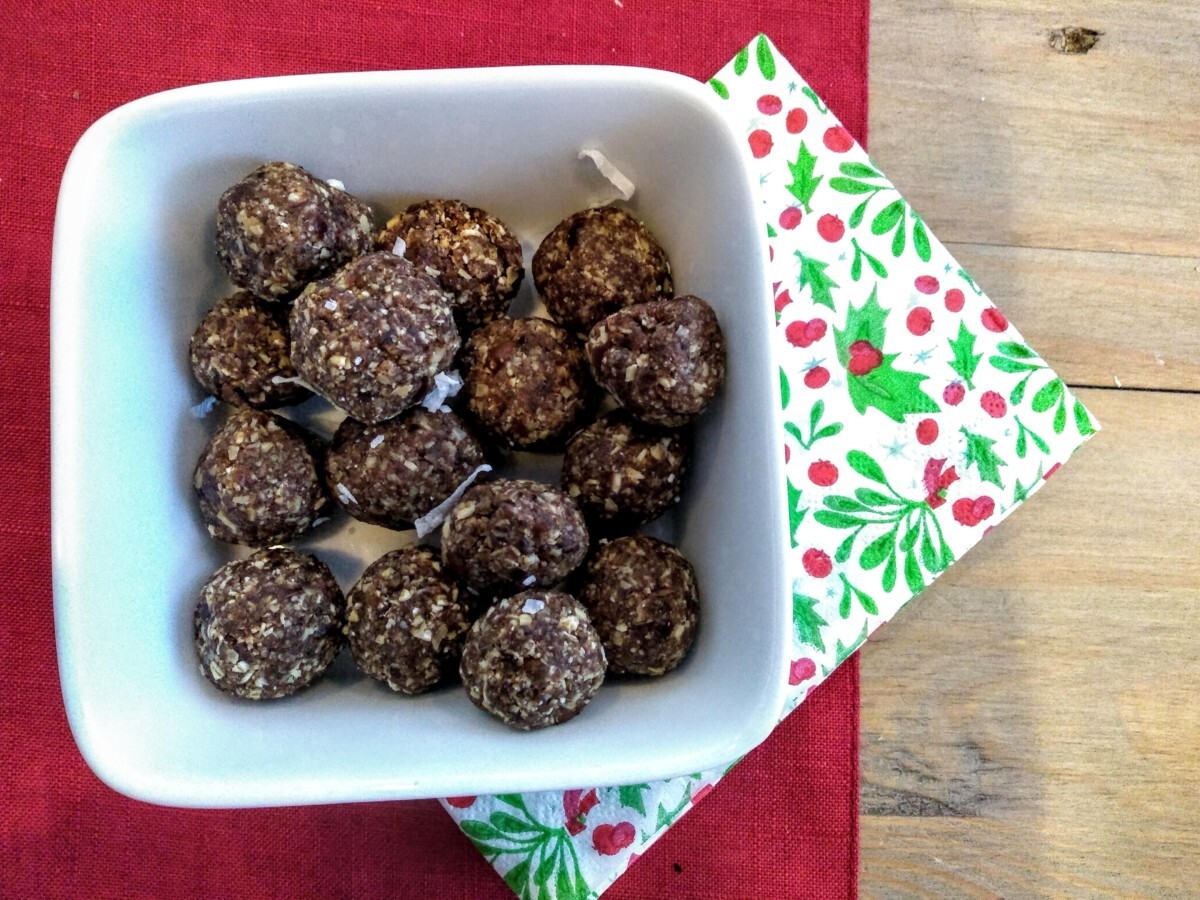
Mix all ingredients, minus dates, into a food processor and blend into a fine flour consistency.
Add 1/2 dates* into food processor and chop until thoroughly combined. Repeat with remaining dates until mixture becomes like a thick dough. *Add water, as needed, for a sticky dough-like texture
Form dough into bite size balls. Sprinkle with coconut flakes (optional) and serve.
Store leftovers in air-tight container in the refrigerator for up to 10 days.
You know how there’s a new diet or nutrition news article coming out every day?! It’s overwhelming and confusing for most people – especially those of us trying to be healthy and make better choices.
For many people, diet is a 4-letter word (literally and figuratively!) that makes one shutter and recoil. Here’s the thing, diet is simply the kind of foods a person eats habitually. It’s often shaped by our culture, environment, and upbringing, which may explain why some of us struggle to make healthier choices.
At Well Balanced Nutrition, Kristen and Lucy make it their mission to stay informed and up-to-date about the plethora of information on nutrition and wellness.
It’s important to remember that each human body, while similar in many ways, is also vastly different in our chemical makeup, including how we metabolize foods, how our bodies respond to stress, and so forth. It’s personal and each of us may require different strategies on the journey.
The Diet Spectrum
To bring more clarity to this conversation, we created a visual guide to help individuals figure out where they are on the spectrum.
On the left, we have our “highly structured” eaters. This includes individuals strictly following a diet, such as Whole30, Paleo, gluten-free, etc. This is not including the 2-week crash diets, but more long-term.
Next, on the far right we have the our “loosey goosey” eaters. On this end, there is almost no structure, boundaries or plan around what someone is eating each day.
In the middle, you find balance. This does not mean someone on a gluten-free diet for medical purposes needs to start eating wheat bread to be balanced. It’s simply a tool to check in and determine where you are on the spectrum.
Where are you on the Diet Spectrum?
Do you find yourself planning what you are going to eat each day before you get hungry? Or are you waiting to decide what you want in the moment day-by-day or meal-by-meal?
To become highly structured may be useful for setting new habits. Sometimes pressing the reset button with a highly structured diet plan can change how we think about or relate to food.
The question is, what do you need to change to create more balance in your diet? For some it may include more boundaries. Yet for others it may include a permission slip to eat off the plan every so often.
Eating balanced feels different for each of us. Letting go of the shame means embracing our slip ups and planning to do better next time.
Food for thought
As you go throughout your day or week, ask yourself is this choice Well Balanced? We find it most helpful to plan ahead! That way the decision is made before we get bombarded with too many choices.
Do you want to find more balance in your diet and lifestyle?Let’s chat!
It’s rare that I meet someone who doesn’t have a sweet tooth. Some of us struggle more than others with sweet cravings. How do we choose to indulge our sweet tooth (or not to) in a healthy way? Here are four mindfulness strategies:
Mindful Pause
Oftentimes, we crave sweets because of some underlying thought or emotion that drives a desire for something comforting. When the craving hits, taking a mindful pause allows us to become aware of our emotions, senses, and actions. We may be frustrated, stressed, tired, or bored and looking to escape those uncomfortable feelings. Unfortunately, we all know those feelings won’t disappear by eating chocolate (although, that would be awesome!). Yet our brain seems to think it will work every time. A little mindfulness and a full toolbox of ways to soothe yourself without food can go a long way when it comes to managing that sweet tooth.
Sort Through the Craving
Ask yourself, do I really want this, or is my primitive brain just craving it because it’s there, free, tempting, etc? If we always follow that primitive drive to indulge, we could end up far from our goals. Having a way to sort through a craving can help. I like to ask myself questions to gather more information. How bad do I really want this? Willt his craving pass pretty quickly? Is this craving for something special and unique? Does this help me meet my needs? Is it going to make me feel good or lousy? Is the experience going to be worth it? For instance, the candy from a jar at work… although delicious, probably not very special. I might devour it as I walk to the water jug without actually experiencing it. But a melt-in-your-mouth s’more when you are on a family camping trip or a decadent homemade pie you only get once a year around the holidays that you sit down to savor with people who mean the world to you… those are the kind of treats that I call worth it. Simply putting a little thought into your decision can help you decide to pass or go on a sweet treat.
Give Yourself Permission
When food is off-limits, it gains power. It’s always your choice to honor a craving or ride it out and let it pass. When you take a mindful pause and sort through it, you can then consciously ask yourself if you still want that food. Give yourself permission to say yes without any judgemental thoughts (like I’m being bad or I’m cheating). Once you do, ironically, it will be much easier to say no if you want to.
Love What You Eat
Cravings can come on for various reasons, but being too restrictive or eating bland food can definitely trigger more cravings. If you aren’t enjoying your food, maybe it’s time to look at how to put more joy and flavor onto your plate. This is different for everyone. Perhaps this means adding a bit of honey and cocoa powder into your morning smoothie, making a flavorful sauce to go on top of your meat and roasted veggies, or ending your meal with fruit or, dare I say, chocolate sometimes!
How can you combat cravings before the start?
Eating Well Balanced Meals can help you stop cravings before they start. If you are not getting the right combination of fat, protein, or carbohydrates at each meal, this could lead to cravings. Schedule an appointment today if you’d like help in this area.
Food for thought:
What food(s) are truly special to you?
What foods do you crave when you are stressed, tired, lonely, or sad?
How will you use this mindful activity to help you manage your cravings? If you like these ideas and want to learn more, we’re happy to help 🙂
Why me? It’s not fair. How did this happen? For 1 in 5 American’s suffering from irritable bowel syndrome (IBS), these are common thoughts and questions that cross the mind. Maybe after a weekend of eating out and enjoying food with friends and family suddenly, cramping, bloating, and discomfort takes over the gut and all you can do is curl up and wait until it passes.
Most of my life I was blessed to eat anything I wanted – I joke that I grew up on Ramen noodles, Pop-tarts, and a lot of chicken casseroles (including broccoli and cauliflower!).
Then came 2012
For 7 years prior to 2012, I was practicing a flexitarian diet, which for me included eating mostly plant-based foods such beans, tofu, peanut butter, and I even started eating lentils. Unfortunately, in November 2012 I contracted a stomach virus. It included a lot of pain and bloating for about five weeks and I lost weight, which at my size was not healthy. When that was over I tried to resume my normal diet. This consisted of salads, plenty of broccoli, apples, and other delicious colorful foods. The problem was some of those same symptoms I had during the virus stated to crop up unexpectedly in the middle of the day or after dinner. More pain. More bloating. But no more virus. I spoke with a good friend (also a dietitian) who recommended I look at eliminating the FODMAP foods – stands for Fermentable Oligosaccharides, Disaccharides, Monosaccharides, and Polyols. For anyone unfamiliar these are foods that have a particular kind of naturally occurring sugar, which are linked to some cases of IBS. She was right! When I stopped eating apples I stopped feeling awful after lunch, at least for a little while. Then by May 2016 while traveling up to Michigan to see my honey I hit a wall (not literally!), but I got fed up with feeling awful. I decided it was time to find out once and for all what was causing my gut issues. I went on an anti-inflammatory elimination diet. These come in all shapes and sizes – I gave up many common culprits including grains, dairy, fermented foods, and legumes. Gasp! At this point you might be thinking “what did you eat?!” For anyone that has done a Whole30 you know that fruits, vegetables, and meat/seafood become the bulk of what you are consuming. During that time, I discovered almond butter isn’t so bad and coconut flour is very versatile and delicious. Otherwise, I started to recognize and address my emotional relationship with food. Turns out, a lot of IBS symptoms are heavily influenced by the gut-brain connection and can be affected heavily by stress and hormones.
So many pity parties
During the first elimination I only committed to 21 days because I knew it was going to be challenging. I learned a lot about my habits, but I did it didn’t give me any conclusive information about what was causing my symptoms. Luckily, my lovely brilliant business partner, Kristen Norton, introduced me to MRT or mediator release testing option, which I did in February 2017. This blood test shows the inflammatory response your body has to 170 foods/chemicals. The test revealed some surprising information, which lead to a significant change in my diet and lifestyle for the next 18 months (and counting). In the beginning, when I first got my results I cut down to eating from a list of 30 approved non-inflammatory foods. Considering on average we consume 700 to 1000 foods and chemicals each week this was a very creative time for me. Who knew all the different ways you could prepare rice, sweet potatoes, tilapia, and carrots? After the MRT results I was informed that alcohol is a huge trigger for IBS symptoms or flare-ups and was advised to stop drinking at least for the first month. Oh, the pity parties. I quickly learned that Friday was a huge trigger for having an alcoholic beverage. I kid you not, it wasn’t until October 13, 2017 that I was finally journaled my first Friday in 8 months that I didn’t crave an adult beverage on Friday night. I promise I don’t have a drinking problem, it was a groove in my brain (aka habit) formed starting in college and apparently became a way of life for the following decade. Not to mention, some of my other favorites I needed to stop eating like lettuce, soy-products, and Duke’s mayonnaise (darn paprika and lemon juice). I cried a lot those first several weeks. Yet, I was finally able to truly empathize with my clients who are doing even harder things in the name of their health and well-being.
What’s the lesson?
While this is still a hard subject for me to talk about, I feel so much better now than I did when I was eating in a way that wasn’t serving my body. Our mission at Well Balanced Nutrition is teach, empower, and connect women that want to feel confident in their food choices and bodies. My body was telling me that my old flexitarian diet was no longer serving me. Our bodies are talking to us all the time. The trick is learning to tune in, listen with compassion, and sometimes swim against the stream to make changes necessary feel our best.
Food for thought What is your body telling you? The first step is tuning in. Next, I encourage everyone to spend time thinking about what better feels like. How will your life change when you feel better? Lastly, you don’t have to do this alone. We can help.
To provide the best experiences, we use technologies like cookies to store and/or access device information. Consenting to these technologies will allow us to process data such as browsing behavior or unique IDs on this site. Not consenting or withdrawing consent, may adversely affect certain features and functions.
Functional
Always active
The technical storage or access is strictly necessary for the legitimate purpose of enabling the use of a specific service explicitly requested by the subscriber or user, or for the sole purpose of carrying out the transmission of a communication over an electronic communications network.
Preferences
The technical storage or access is necessary for the legitimate purpose of storing preferences that are not requested by the subscriber or user.
Statistics
The technical storage or access that is used exclusively for statistical purposes.The technical storage or access that is used exclusively for anonymous statistical purposes. Without a subpoena, voluntary compliance on the part of your Internet Service Provider, or additional records from a third party, information stored or retrieved for this purpose alone cannot usually be used to identify you.
Marketing
The technical storage or access is required to create user profiles to send advertising, or to track the user on a website or across several websites for similar marketing purposes.