by Lucy | Nov 2, 2016 | Well Balanced Wisdom
I love fall. The weather is cooler, the leaves change color and it’s the perfect time to get outside. Not to mention it marks the beginning of many celebrations and holidays to come…which is a wonderful thing and a challenging thing all at once.
Halloween is the first celebration of the season and boy was that fun! Don’t you just love seeing kids in their costumes all giddy for candy? And walking past all the houses with spooky decorations?
Of course, my 3-year-old wanted to be Elsa and my little guy was an adorable dragon. They did a great job of collecting tons of goodies in their plastic pumpkin buckets, but now I am dealing with the aftermath.


Candy on the brain. It’s all my little Elsa wants in the morning and in the afternoon and before bed. She sees that plastic bucket and she wants to consume all the candies! If you give her one she asks for “one more” and then “one more.”
Can you blame her? I can’t. She is just like her mom. I see the candy sitting out and I grab a piece. Then I think to myself, ” maybe just one more.” I am not a good moderator with chocolate and cookies. I do much better if it’s out of sight, out of mind.
So here is my 2 part strategy for the Halloween candy stash.
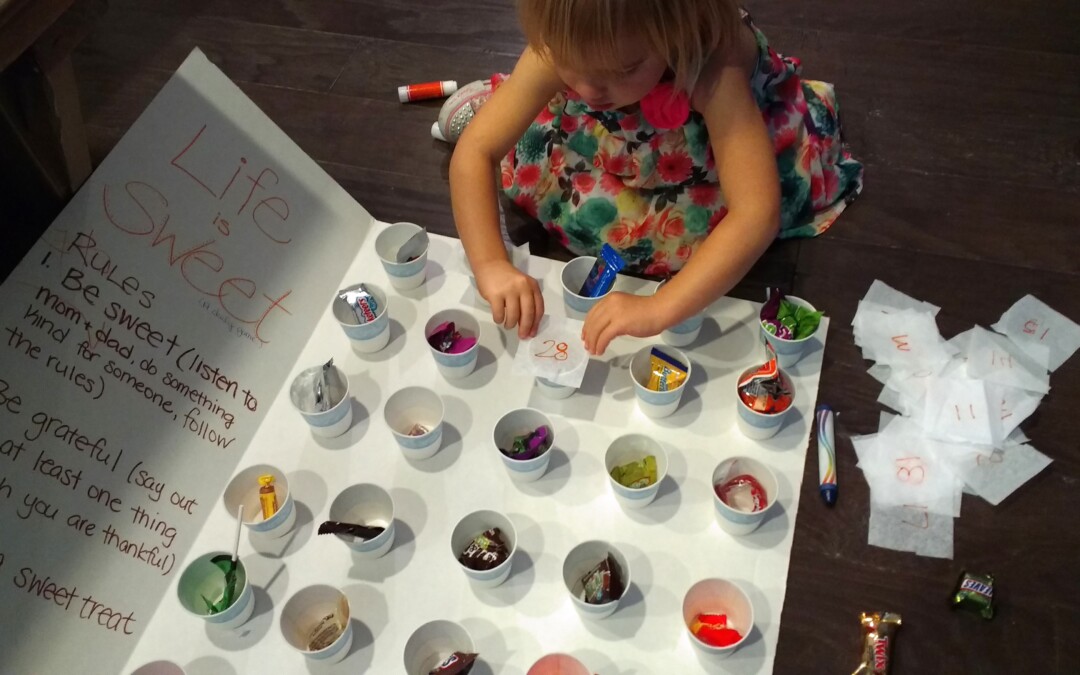
- I created a game board that I titled LIFE IS SWEET. I found a poster board and wrote the rules of the game: (1) Be sweet. (2) Be grateful. (3) Enjoy a sweet treat. I taped/glued on 30 paper cups and let my little girl pick out 30 of her favorite pieces of candy which she then put in each cup. I covered the cups with a square of tissue paper labeled 1-30. Now every day in November after we recall the ways in which she was sweet that day – for instance, being a good friend, listening to mom and dad, being kind to her brother – and say out loud one thing she is thankful for she can enjoy a treat. (By the way, the two things she is grateful for so far are candy and macaroni and cheese! Ha!)
- I put the rest out of sight so it can be out of mind. I froze the rest of the chocolate candy to pull out on special occasions throughout the next 10 to 12 months or when the dire craving hits. The non-chocolate candy went in the cabinet.
I’m hopeful that the 2-part strategy will eliminate the desire to overindulge and create a fun element to enjoying the candy over time.
Food for thought:
Are you a moderator or an abstainer when it comes to Halloween candy? How about other holiday treats?
What strategies can you use to make it easier to avoid overindulging when ______ is present in abundance?
by Lucy | Oct 28, 2016 | Motivational Mondays
Monday, October 31st
Farm animals… Check
Meat on a stick… Check
Flying acrobatic dogs… Check
Deep fried dough… Check
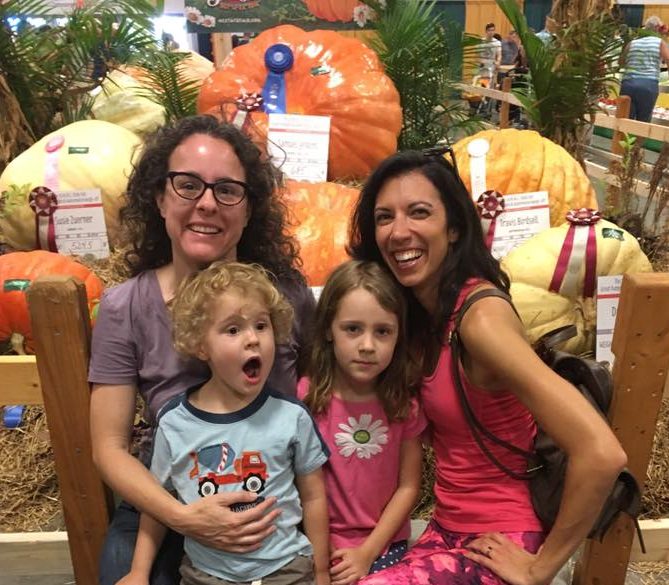
All signs point to a fun-filled experience at the North Carolina State fair. One thing I didn’t expect to get from the experience was a wonderful opportunity to practice mindfulness and self-care. While walking through crowds of people from all over the state it would have been easy to get annoyed or frustrated every time a stranger ran into me or cut us off in mid-stride. Instead, I noticed how my mind responded to each encounter. See a few of these insights below.
Lessons learned at the fair:
- I really don’t enjoy big crowds anymore – My dad has been saying this for years and I used to think he was kind of lame. Now I respect his decision because frankly hanging out with a lot of other people – especially strangers – can be sort of exhausting.
- I should always pack a lunch – even just a peanut butter jelly sandwich. I know, I know
 the food is half the fun at the fair. However, knowing that I have something well-balanced on hand and not being subject to the deep-fried, calorie dense fluff gives me the peace of mind to make a mindful and delicious decision (like a frozen chocolate covered banana!) in the face of too many choices.
- Staying well hydrated is imperative. I should always fill up my water when I have the opportunity because the next water fountain might be broken.
- Practice mental health exercises before, during, and after. I need to do 30 minutes of exercise such as a brisk walk or short jog before potentially stressful or draining events. Exercise is my form of mental health, maybe for you relaxing includes reading a good book, doing crafts, or talking to a friend.
- Stay in the moment. Appreciate humanity. Take pictures and smile because you’re having fun. Don’t let one person stepping on your toes (literally or figuratively!) ruin the rest of the experience.
Food for thought:
What are some of your self-care truths? You can discover this by filling in the blank:
I feel most peaceful and happy when: _____________________________________________________.
When are you not taking caring of yourself?
I feel overwhelmed and irritable when: ____________________________________________________.
With the holidays rapidly approaching, I encourage each of you to list at least 3 ways you can take care of yourself during this festive and fun-filled season.
- _____________________________________
- _____________________________________
- _____________________________________
- Bubble bath at least 1x/week
- Getting a great book to read when I need to relax
by Lucy | Oct 26, 2016 | Well Balanced Wisdom
Calories, calories, calories. So important, yet so frustrating. We know eating more calories than we burn will cause weight gain, right? So, why don’t we all just track our calories daily and everyone will be at a healthy, happy weight? Simple! America’s weight problems SOLVED!
You and I know it’s not that simple. If this method worked, Lucy and I would need to start looking for another job.
Calories aren’t everything. Eating a low-calorie diet does not equate to eating healthy. If you are on the twinkie diet, a fast food diet or possibly a fad diet, you may be malnourished. Plus your body reacts differently to a 100 calorie cookie compared to 100 calories of fruits or vegetables. Processed foods can signal your body to store fat, while whole and natural foods can help you burn fat AND feel more satisfied.
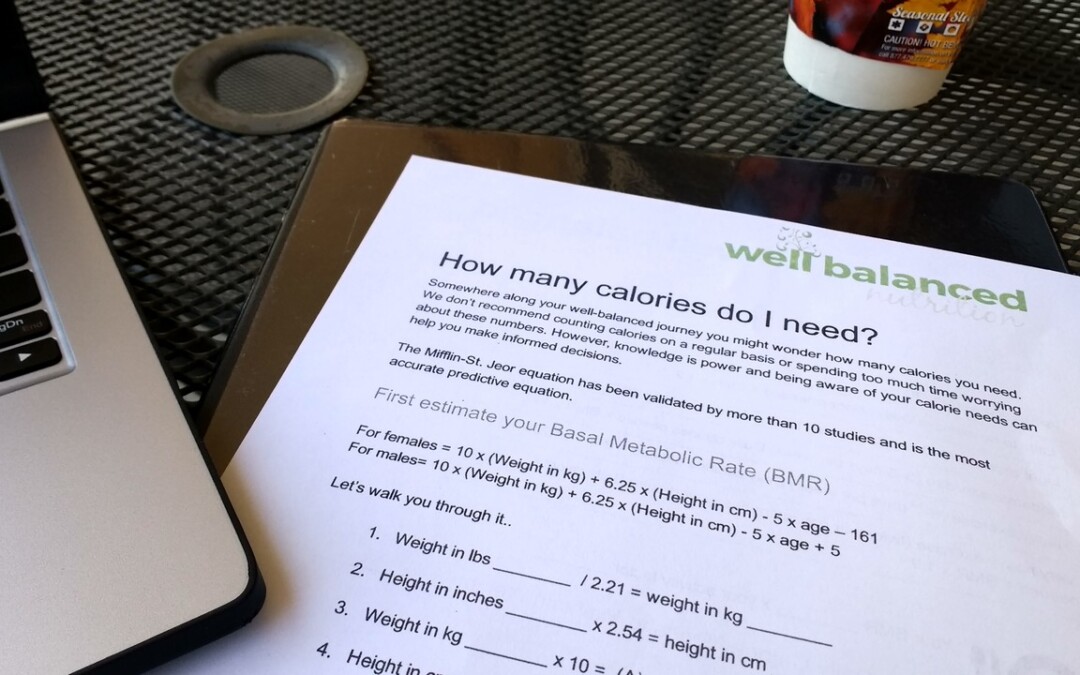
At some point in your well-balanced journey, you might wonder how many calories you need and seek guidance getting there. You may find it helpful to keep track of your calorie intake for a few days. Monitoring how many calories we eat can help us maintain or lose weight in the short term, it can waste valuable time and energy in the long term.
Recently, two of my clients came to realize this truth. For a few days, calorie counting was a great opportunity to see part of the puzzle. It was a good experiment. But it was only a small part of their puzzle and it had its downfalls. They were finding themselves thinking about food all the time, obsessing over the calorie counts, and feeling anxiety about it all day long. That’s no way to live.
We can help you figure out how many calories you need but more importantly we help you figure out how to eat well balanced without being a slave to daily calorie counting.
FOOD FOR THOUGHT:
Rather than focusing time and energy on counting calories, take a step back and look at the whole picture. Spend more time and energy on preparing home-made food, slowly enjoying your food, balancing your plate and filling it with mostly natural or plant-based foods, taking care of yourself and managing your stress.
by Lucy | Oct 20, 2016 | Motivational Mondays
Monday, Oct 24th
I often have people bring me food containers to determine if it’s a healthy option or not. You may have seen or heard that the FDA is working on redefining the term “healthy” on food labels due to an ongoing battle with Kind Bars.
Here’s the quick and simple Well-Balanced Way to know if you are making a healthy choice:
- Can you read, pronounce and explain all the ingredients on the ingredients list?
Polydextrose, soy lecithin, anhydrous milk fat, glycerin, hydrolyzed gelatin… These are just a few ingredients found in the Atkins Advantage Bar.
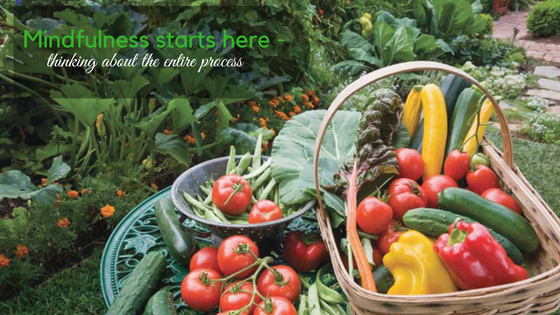
A good guideline for the ingredients issue, can you explain to a 3-year old where it came from and why it is in your food? See Mindfulness starts here – thinking about the entire process.
- How many ingredients does it include?
I made an interesting discovering while looking at a label for lightly salted dry roasted peanuts – you’re thinking it’s peanuts and salt, right? Yea, plus the 13 other ingredients to add flavor and shelf-life. Yikes!
- How big is the portion size?
Portion size is at the very top of the label because it’s super important! Some companies still use an unusually small portion size (I’m looking at you ice cream containers) that many people do not follow. The consumer assumes they are doing great because “it’s only 220 calories per serving!” Nevermind, that they polished off the entire pint and now that 220 calories has turned into an extra 880 calories. WOW!
- What is the sodium content?
This is more important for some than others, especially if you have salt-sensitive hypertension (high blood pressure). Most of us would benefit by decreasing our sodium intake; however, at Well-Balanced Nutrition we want you to season your foods! The amount of salt added at restaurants and fast food chains will almost always be significantly more than what you prepare at home.
- What’s the goal?
Is this a snack or a meal? If you have not had the pleasure of playing Lucy’s game good vs better it’s important to note there is no “bad food.“
There are good choices and better choices. Of course, I’m not encouraging cookies for breakfast, but that may be better than going hungry. A better choice than cookies is whole wheat toast, peanut butter, and a piece of fruit.
Food for thought:
Is your food really as healthy as the label claims? There may be more to the story than they want you as the consumer to know. Now you have more tools and knowledge to arm yourself for your next trip to the grocery store!
List the top 3 foods you will compare next time you go grocery shopping:
- _______________________________
- _______________________________
- _______________________________
by Lucy | Oct 19, 2016 | Well Balanced Wisdom
One of the very nicest things about life is the way we must regularly stop whatever it is we are doing and devote our attention to eating. -L. Pavorotti
Crumbs fell on my desk… It’s about 10:30 am and I was listening to the audio version of the Blue Zones Solutions, a book by Dan Buettner on the secrets to longevity. In my ear, I heard Buettner tell stories about 5 different communities where the majority of the people live long lives free of afflictions like heart disease, obesity, cancer, and diabetes.
I was learning about the lives of centenarians who were still vibrant and full of life. Each one of them had their own unique story – full of tragic moments and triumphant ones. When it came to the question of what they ate to live such healthy lives, the answer varied a bit but there was one thing I noticed they all had in common. Food wasn’t something they got at the grocery store or a restaurant. Food was an integral part of their everyday lives. From planting a seed, harvesting the fruit, to soaking the beans, food was something they cultivated from the ground up. They were fully involved in the entire process.
Here I was mindlessly snacking to tame my mid-morning hunger. As I looked down at the fallen crumbs on my desk, I thought of how far removed most Americans, including myself, have come from the entire process. We eat several times without having to do any of the growing, the tending, the harvesting or even the preparing of the food. We just consume without thinking twice about who, what, when, where and how this food came to be sitting in front of us. In fact, food is so much of an afterthought in our culture. Everything else is more important and food is sometimes the last thing we think about. Convenience and multitasking have somehow become things we value most and this left me wondering how we can make our way back to the mindset that food is worth our time, effort and appreciation because food gives us life.
There is something to be said about being connected to where our food comes from, having a hand in preparing it and sitting down to mindfully enjoy it. It was something that just came naturally to these centenarians. I think it can come to us all naturally if we just tune in a little more. We can grow some of our own food, get to know and buy from our local farmers, stop and think about the work that went into our food when someone else grows and prepares it, and focus on eating it. While it was only one component in the lives of the centenarians, it is an important one that we can learn from. It’s really where mindfullness begins.
So, I turned off the audiobook. Looked at my granola bar and savored that last few bites. Food is a wonderful thing. It sustains us and nourishes us. It gives us the fuel we need to move, love, think and serve. Any small step we can take toward participating in the entire process is worthy of our time and effort.
What can you do today or this week to be more mindful of your food? Here are just a few ideas to get you thinking.
- Plant some kale or lettuce in a container for the cool months ahead.
- Get to know a farmer from your farmer’s market this weekend or sign up for a CSA or produce box.
- Prep some meals in advance this weekend and get family and friends involved in the process
- __________________________________
- __________________________________