Like many of you, Christina is a busy professional who is in a position of leadership. She was a pretty healthy gal before she started coming to see me, but she wanted to do even better, especially as a leader in the office. Her wellness WINS are highlighted below. Her story is a reminder of how our behaviors not only impact our own lives but also those with whom we work.
Making self-care a priority
Christina hates running but she found that training for a 5K and 10K race last year kept her inspired to exercise consistently. She pushed herself because she knew being active was important for her health. To fuel her life she enjoys healthy vegetarian foods. She especially loves anything with chickpeas and fresh vegetables.
Inspiring and encouraging others
Not only do Christina’s coworkers notice and get inspired by her healthy meals she brings from home every day but they also see her taking an active role on the employee wellness team. Plus, after enjoying a fun well-balanced walking session with me around downtown Durham, she incorporated walking meetings with her staff. How fun is that!?
She also cares about her friends and encourages them to adopt healthy habits. One example includes suggesting busy professional friends invest in a meal delivery service, which can make it easier to prepare fresh and well-balanced meals at home.Click here if a meal delivery service sound interesting to you.
Now it’s your turn.
A healthy and happy team is a more motivated and productive team. Here are 3 healthy leadership tips we can all learn from Christina.
Lead by example – It starts with you. Christina found an exercise strategy that worked for her. She also packs her lunch with leftovers and keeps healthy balanced options in her desk, like that can of chickpeas :-P.
Make it fun and do what you can – Would you rather sit windowless office for meetings or enjoy some sunshine? Take your team out for a walk like Christina or break up your long meeting with a fun mini activity break. It does not need to be a sweat session, just let everyone get up or get out and move their bodies.
Provide/create a nurturing environment– Donuts and candy dishes look fun but often leave people feeling guilty or sluggish after the sugar buzz wears off. Do you have sliced veggies and a fruit for an easy colorful side dish with lunch or dinner? To live healthy and happy we need to set ourselves (and others) up for success, y’all. Check out Kristen’s blog for a few more ideas.
Food for thought
We have an opportunity to positively impact those around us, whether it’s our family, friends or coworkers. How are you leading yourself and others to healthy habits?
Which healthy leadership strategy are you already rocking?! Let us know in comments below or give a shout out to the healthy role model in your life!
Until recently, I have been eating upside down. No, not eating while standing on my head – that would be an interesting site. Ha.
I was starting my day off with too little calories and eating most of my calories toward the end of the day. That’s a bit upside down considering we need good fuel during the day when we are moving, thinking, working, walking, and doing all the things and at night we tend to slow down, relax and unwind – things that don’t require as much fuel.
When you are busy, it can feel hard to give breakfast the attention it deserves. For a while, it was the last thing on my mind in the morning (even though I was fixing my kids a good breakfast). I was just grabbing something small that would satisfy me for the moment. As Lucy explained a few weeks ago, eating too little early in the day can easily lead to overcompensating in the evening. This was definitely true in my case. I was feeling hungry and deprived by the afternoon. Then, my belly would start hurting. I’d eat too quickly at dinner time and then my belly would hurt even more. Ugh. It was not a good cycle. Can you relate?
Is breakfast that important?
In general, eating breakfast has been associated with lower body weight. Seventy-eight percent of those who have lost weight and kept it off for a year or longer are regular breakfast eaters. Breakfast has also been shown to increase fullness while reducing appetite, food cravings, and brain signals that regulate reward-driven eating behavior. Furthermore, studies show that eating a high-quality, high-protein breakfast decreases late-night snacking of foods high in sugar and fat.
So, if food cravings and late night snacking are things you struggle with, I highly recommend focusing on your breakfast. Perhaps you are eating upside down, too? Try a high-quality, high-protein breakfast.
What is a high-quality, high-protein breakfast?
Well, first, your breakfast should be made of real food. I know it’s super tempting to just grab a protein bar or granola bar on your way out the door, but those protein and granola bars often include a lot of artificial ingredients and added sugars and is far from what nature intended. This is not to say it’s never okay to have them. They should just be a backup breakfast instead of a go-to breakfast.
Secondly, you want to aim for a breakfast that contains between 20 and 30 grams of protein. Here are some examples of what that might look like:
Two Egg Omelet with leftover veggies, 1 oz of beef and cheese = 29 grams protein
Egg and Canadian Bacon Breakfast Sandwich on English Muffin = 26 grams protein
8 oz Greek Yogurt with 1 oz Nuts = 26 grams protein
Peanut Butter Quinoa = 31 grams protein
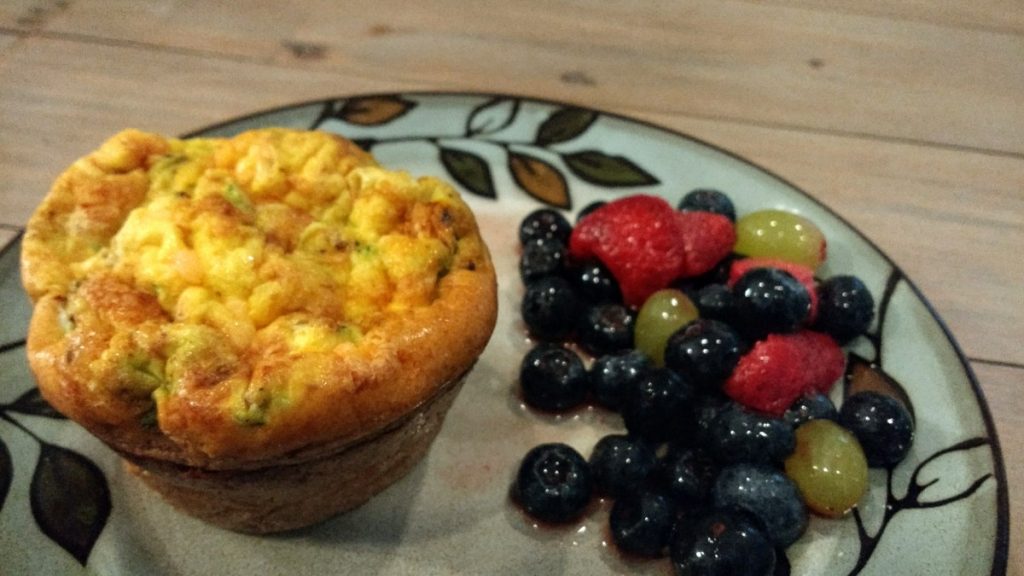
Easy Morning, Egg, Potato and Zucchini Cups with fruit and yogurt = 30 grams protein
If you are like me and have busy mornings that can feel rushed, you may like this make-ahead option that works for me.
Kristen Norton, RD, LDN
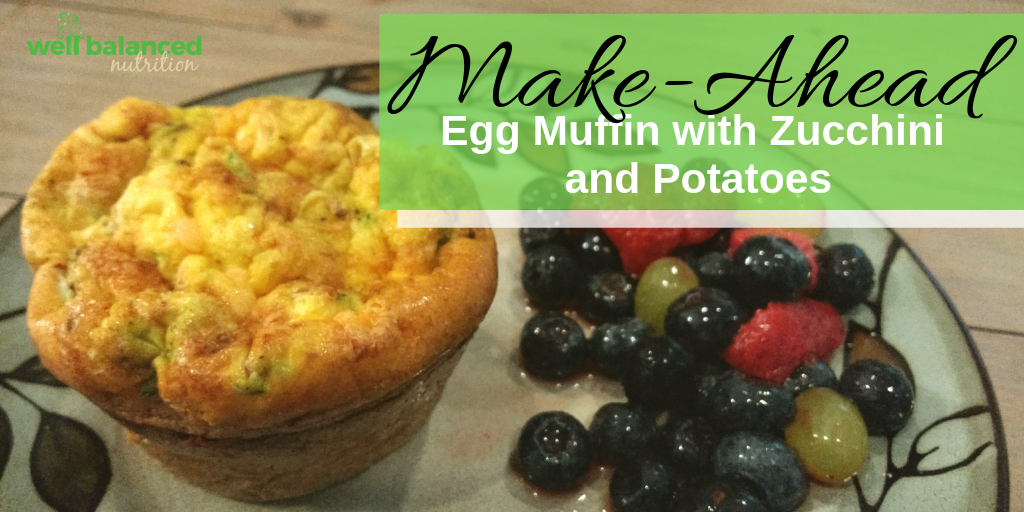
Easy Morning Egg, Potato and Zucchini Cups
These can make your morning easy-peasy and delicious! Make them on the weekend and reheat them each day. They go great with yogurt and fruit or avocado and fruit.
Evenly distribute the hash-browns in each cup. Then the shredded zucchini and cheese.
In a bowl, whisk the eggs and add in salt, pepper, turmeric and a savory all purpose blend (or use your favorite blend).
Pour egg mixture into each cup Give each cup a little stir and bake for 20-25 minutes.
Notes
To reheat: Place on microwave safe plate and heat for 1 minute 15 seconds on 50% power. Add 10-15 more seconds as needed. Nutrition Facts: Calories 312, Protein 16g, Carbohydrate 14 g, Dietary Fiber 1 g,
Total Sugars 2g, Total Fat 21g, Saturated Fat 7g, Monounsaturated Fat 9g, Polyunsaturated Fat 3g
Food for thought: Let me know if you try these and what you think! Or share with us your favorite make-ahead high-quality protein-packed breakfast.
Your food environment can set you up for success or it can make healthy living a struggle. Last week, we gave you a checklist for your countertops and your pantry. In part TWO of the spring cleaning series, we have a checklist for your FRIDGE.
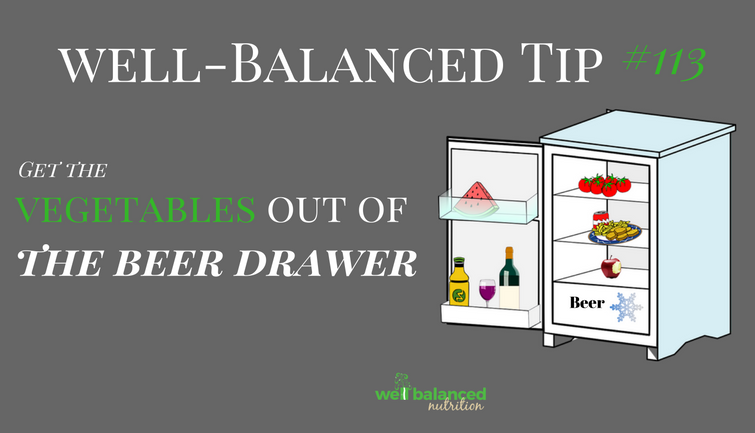
It’s all about visibility and convenience. The most visible foods are the ones we eat first. Research tells us that we are 3 times as likely to eat the first thing we see then the 5th. So, if there is any question at all, you’re going to choose that piece of chocolate that is front and center of your fridge instead of the veggies hidden in the back or in a drawer – the beer drawer as Lucy calls it. =)
Here are 6 fridge-hacks that will make your fridge your friend. You can choose to do them all or tackle one at a time, it’s up to you!
1. Take the veggies out of the crisper drawers and place them at eye level. Put the less healthy items in the drawers. When people did this for just one week, they reported eating almost 3 x as much produce as they did the week before.
2. Better yet, cut them up first. Making fruits and vegetables convenient to grab-and-go increases your chance of eating them. Keeping a bunch of oranges in your fridge is one thing, but cutting them up so they can be devoured quickly makes them even more attractive.
3. Keep foods you want to eat in clear packages and at eye level. If you want to eat your salad or your vegetable leftovers the worst thing you can do is put them in aluminum foil. Instead, use clear containers that make the food visible.
4. Keep foods that you don’t want tempting you, wrapped in foil and placed in the back. Same concept as above, we eat what we see. Maybe you still have some girl scout cookies or a whole pie in your fridge that you don’t want to eat. Wrap them up and send them to the back so they are out of sight, out of mind.
5. If you are a soda drinker, moderation is important. Keep 2 or fewer cans in the fridge. This slows down how much you drink because warm soft drinks aren’t as tempting. You could even keep sodas in the garage or some other inconvenient place.
6. Always stock at least 6 single-serving, easy-to-grab, nutritious snacks. Snacks containing lean protein will sustain and satisfy you like cottage cheese cups, Greek yogurt, cheese sticks, and boiled eggs. Other great snack options are single servings of hummus, guacamole, and nut butter for pairing with your precut veggies.
Any easy way to eat 3x as much produce: keep the veggies out of the drawers and put them at eye level instead.
*These suggestions are based off research from Brian Wansink, author of Slim By Design.
Food for thought:
Which fridge-hacks will help you the most and why?
Have you already implemented these tricks?
What worked well for you? Tell us in the comments below.
I originally heard this phrase, “do first what is most important,” from pastor Kendrick Vinar at Grace Church. It applies to all parts of life. Especially important when we are distracted by shiny objects all day, every day. (Yea, I’m looking at you Pinterest and my shiny new iPad)
Often, folks tell Kristen or me about how they want to live healthier, eat better, include more exercise, and manage their stress; however, they just don’t have time.
Then there are examples like a Jeanie. Jeanie is a dental hygienist at a busy community dental clinic and has been trying to lose weight for the past six months. Each time we meet, Jeanie has a new kitchen tool or smartphone application that is going to fix all her unhealthy habits. Then, the next month there is another new program or app that she’s found. Most of these tools have helped her figure out what is not going to work. It wasn’t until the celiac diagnosis that inspired Jeanie to make some real some changes. For those of you unfamiliar with this disease, Celiac disease is an autoimmune condition that damages the small intestine after ingesting gluten. It occurs in 1 out of 133 American’s – about 1% of the population – and has contributed to some of the gluten-free craze, which is currently sweeping our nation.
Back to Jeanie’s story, after being diagnosed she quickly made many changes to her schedule to make time to cook, which she previously assured me she had no time for. She found support groups and contacted her favorite dietitian to get started. Then, she bought a cookbook with a gluten-free meal plan to help learn how to cook/eat without gluten. For her health, Jeanie knows this diet and lifestyle change needs to become permanent, unlike previous efforts that have come and gone. That’s why she has put this at the top of her priority list and made taking care of herself and her health most important during this transition.
Too often, I see people putting their health at the bottom of the proverbial to-do list.
| She has put this at the top of her priority list and made taking care of herself and her health most important during this transition. |
Food for thought:
What is at the top of your priority list? That’s easy to figure out by looking at what is on your calendar or to-do list.
What habit or shiny object is currently taking your time or energy from focusing on your health?
If you gave up a “bad habit” during the Lenten season, do you really need to re-introduce that habit, food, or beverage just because today is Easter?
Sally was feeling sluggish and exhausted all day long. No matter how healthy she was eating, she always felt hungry, craved sweets and even experienced shakiness in between meals. It was frustrating, to say the least.
What could possibly be going wrong? A closer look at her diet and it became clear that her healthy eating patterns were full of unwanted sugars and sometimes lacking in healthy fats. She didn’t realize it but added sugars were in almost everything she was eating. Foods that seemed healthy on the surface were actually not very nourishing and she lacked balance at her meals. After cleaning up her habits a bit and focusing on more natural foods she was feeling more sustained and her cravings were significantly decreased.
Your turn. Are you ready to clean up your eating environment? Spring is when we tend to open our windows at home, clean out all the dust and clutter from the colder months and welcome in fresh air, good energy and sunshine. Below is a checklist of things you can do to clean up your eating habits and food environment, starting with your pantry and countertops. Pick one or check them all off, it’s up to you!
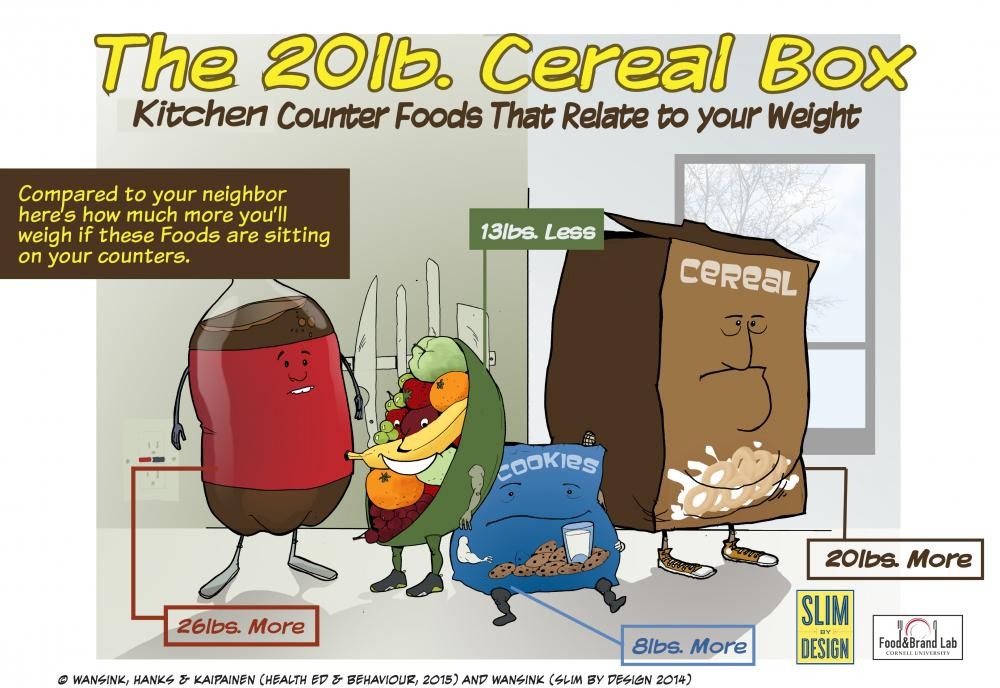
Ditch the cereal and switch things up with an egg and veggie omelet, our high protein cookies or a Greek yogurt parfait. Protein is just as important at breakfast as it is at dinnertime. We should evenly distribute our protein intake throughout the day instead of overloading at our last meal. Cereals just don’t have much protein to offer and often contain lots of sugar. If you need more convincing, a Cornell study found that women who had breakfast cereal sitting on their counters weighed 20-lbs more than their neighbors who didn’t. At very minimum, keep your cereal tucked away in your pantry. Use it to make a fun trail mix or as an afternoon treat.
Find at least 2 foods in your pantry (or fridge) with added sugars and seek alternatives to these products. Start checking the ingredient lists on your foods and you will soon realize that sugar, much like salt, is added to just about everything. Some surprising places you will find sugar is in your pasta sauce, mustard, mayonnaise, barbecue sauce, fat-free salad dressings, and canned beans. Added sugars are also abundant in yogurt and whole grain products. Women should keep their added calories to 6 teaspoons or 25 grams per day.** If we aren’t careful all those little doses from unsuspecting places can add up! Then we won’t have room for a teaspoon in our coffee or a piece of dark chocolate. (GASP!) We don’t want to miss out on that, now do we?
Keep your favorite junk foods out of the house or at least hard to reach. Out of sight, out of “stomach.” There are certain foods that we tend to overeat, especially when stress hits. These foods are different for everyone. You might not be able to resist ice cream, while someone else may be more tempted by a bag of potato chips. Whatever foods seem to tempt you the most, should be the ones you keep out of the house. These foods aren’t forbidden, we just don’t want to make them readily available and convenient. But what if you have hungry kids or unwilling family members? Keep all tempting snacks in a hard to reach, inconvenient cabinet – not at eye level. Wrap items in the freezer, like ice cream, in aluminum foil. They will be less tempting when you can’t see the package.
Only keep 1-2 sodas in your fridge at one time and make water easily accessible. Occasionally, a sweet drink is fine but when you are doing it regularly you are putting yourself at risk for health concerns and sugar crashes. To cut back keep sodas off your counter and only one or two in your fridge at a time. In the same study mentioned above, those with soft drinks sitting out on their counter weighed 24 to 26-lbs more than those who didn’t.
To end on a positive note: those who had fruit on their counter weighed LESS and likely ate more fruit. So, clear off those countertops, hide the junk and put the nourishing fruit on display!
It’s all about setting yourself up for well-balanced success. Bring on the good energy and life-sustaining eating habits! Happy cleaning!
Food For Thought: Will any of these spring cleaning tasks work for you? Why or why not? Which one(s) will you try today? Comment below.
*These suggestions are based off research from Brian Wansink, author of Slim By Design. Check it out!
**The American Heart Association recommends reductions in the intake of added sugars. A prudent upper limit of intake is half of the discretionary calorie allowance, which for most American women is no more than 100 calories per day and for most American men is no more than 150 calories per day from added sugars.
To provide the best experiences, we use technologies like cookies to store and/or access device information. Consenting to these technologies will allow us to process data such as browsing behavior or unique IDs on this site. Not consenting or withdrawing consent, may adversely affect certain features and functions.
Functional
Always active
The technical storage or access is strictly necessary for the legitimate purpose of enabling the use of a specific service explicitly requested by the subscriber or user, or for the sole purpose of carrying out the transmission of a communication over an electronic communications network.
Preferences
The technical storage or access is necessary for the legitimate purpose of storing preferences that are not requested by the subscriber or user.
Statistics
The technical storage or access that is used exclusively for statistical purposes.The technical storage or access that is used exclusively for anonymous statistical purposes. Without a subpoena, voluntary compliance on the part of your Internet Service Provider, or additional records from a third party, information stored or retrieved for this purpose alone cannot usually be used to identify you.
Marketing
The technical storage or access is required to create user profiles to send advertising, or to track the user on a website or across several websites for similar marketing purposes.