by Lucy | Nov 2, 2016 | Well Balanced Wisdom
I love fall. The weather is cooler, the leaves change color and it’s the perfect time to get outside. Not to mention it marks the beginning of many celebrations and holidays to come…which is a wonderful thing and a challenging thing all at once.
Halloween is the first celebration of the season and boy was that fun! Don’t you just love seeing kids in their costumes all giddy for candy? And walking past all the houses with spooky decorations?
Of course, my 3-year-old wanted to be Elsa and my little guy was an adorable dragon. They did a great job of collecting tons of goodies in their plastic pumpkin buckets, but now I am dealing with the aftermath.


Candy on the brain. It’s all my little Elsa wants in the morning and in the afternoon and before bed. She sees that plastic bucket and she wants to consume all the candies! If you give her one she asks for “one more” and then “one more.”
Can you blame her? I can’t. She is just like her mom. I see the candy sitting out and I grab a piece. Then I think to myself, ” maybe just one more.” I am not a good moderator with chocolate and cookies. I do much better if it’s out of sight, out of mind.
So here is my 2 part strategy for the Halloween candy stash.
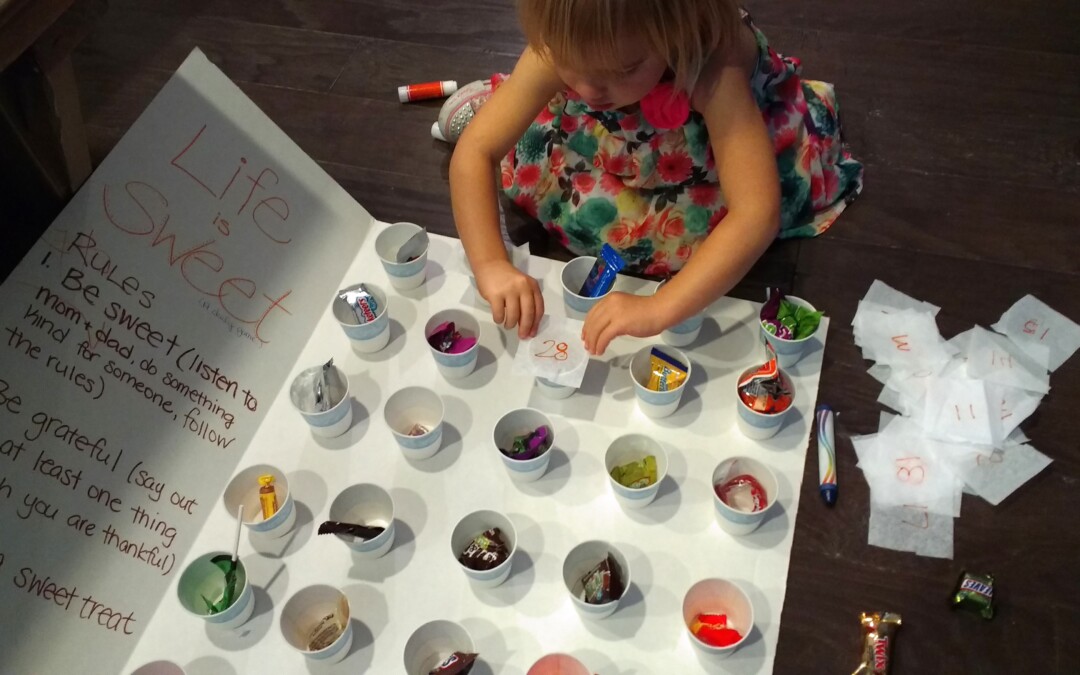
- I created a game board that I titled LIFE IS SWEET. I found a poster board and wrote the rules of the game: (1) Be sweet. (2) Be grateful. (3) Enjoy a sweet treat. I taped/glued on 30 paper cups and let my little girl pick out 30 of her favorite pieces of candy which she then put in each cup. I covered the cups with a square of tissue paper labeled 1-30. Now every day in November after we recall the ways in which she was sweet that day – for instance, being a good friend, listening to mom and dad, being kind to her brother – and say out loud one thing she is thankful for she can enjoy a treat. (By the way, the two things she is grateful for so far are candy and macaroni and cheese! Ha!)
- I put the rest out of sight so it can be out of mind. I froze the rest of the chocolate candy to pull out on special occasions throughout the next 10 to 12 months or when the dire craving hits. The non-chocolate candy went in the cabinet.
I’m hopeful that the 2-part strategy will eliminate the desire to overindulge and create a fun element to enjoying the candy over time.
Food for thought:
Are you a moderator or an abstainer when it comes to Halloween candy? How about other holiday treats?
What strategies can you use to make it easier to avoid overindulging when ______ is present in abundance?
by Lucy | Oct 26, 2016 | Well Balanced Wisdom
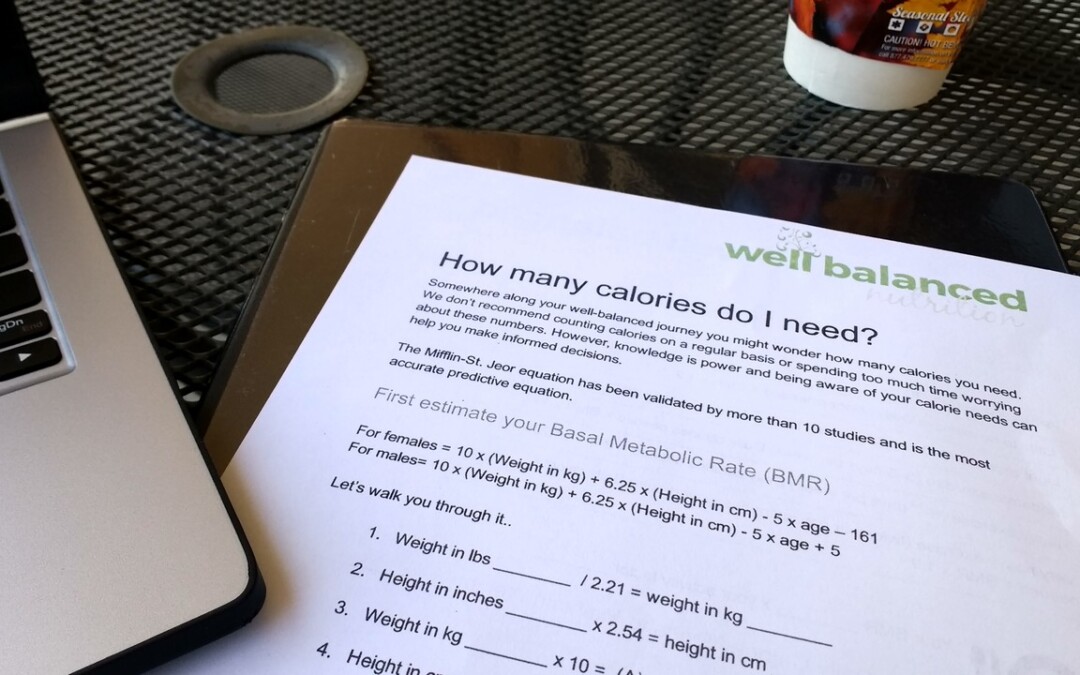
Calories, calories, calories. So important, yet so frustrating. We know eating more calories than we burn will cause weight gain, right? So, why don’t we all just track our calories daily and everyone will be at a healthy, happy weight? Simple! America’s weight problems SOLVED!
You and I know it’s not that simple. If this method worked, Lucy and I would need to start looking for another job.
Calories aren’t everything. Eating a low-calorie diet does not equate to eating healthy. If you are on the twinkie diet, a fast food diet or possibly a fad diet, you may be malnourished. Plus your body reacts differently to a 100 calorie cookie compared to 100 calories of fruits or vegetables. Processed foods can signal your body to store fat, while whole and natural foods can help you burn fat AND feel more satisfied.
At some point in your well-balanced journey, you might wonder how many calories you need and seek guidance getting there. You may find it helpful to keep track of your calorie intake for a few days. Monitoring how many calories we eat can help us maintain or lose weight in the short term, it can waste valuable time and energy in the long term.
Recently, two of my clients came to realize this truth. For a few days, calorie counting was a great opportunity to see part of the puzzle. It was a good experiment. But it was only a small part of their puzzle and it had its downfalls. They were finding themselves thinking about food all the time, obsessing over the calorie counts, and feeling anxiety about it all day long. That’s no way to live.
We can help you figure out how many calories you need but more importantly we help you figure out how to eat well balanced without being a slave to daily calorie counting.
FOOD FOR THOUGHT:
Rather than focusing time and energy on counting calories, take a step back and look at the whole picture. Spend more time and energy on preparing home-made food, slowly enjoying your food, balancing your plate and filling it with mostly natural or plant-based foods, taking care of yourself and managing your stress.
by Lucy | Oct 19, 2016 | Well Balanced Wisdom
One of the very nicest things about life is the way we must regularly stop whatever it is we are doing and devote our attention to eating. -L. Pavorotti
Crumbs fell on my desk… It’s about 10:30 am and I was listening to the audio version of the Blue Zones Solutions, a book by Dan Buettner on the secrets to longevity. In my ear, I heard Buettner tell stories about 5 different communities where the majority of the people live long lives free of afflictions like heart disease, obesity, cancer, and diabetes.
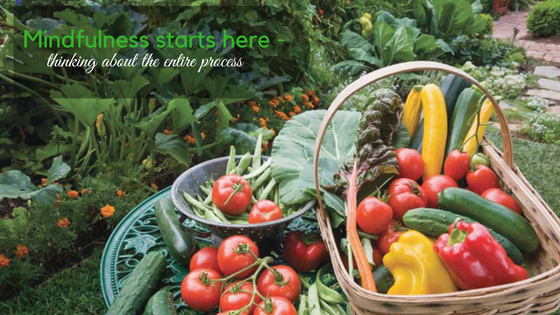
I was learning about the lives of centenarians who were still vibrant and full of life. Each one of them had their own unique story – full of tragic moments and triumphant ones. When it came to the question of what they ate to live such healthy lives, the answer varied a bit but there was one thing I noticed they all had in common. Food wasn’t something they got at the grocery store or a restaurant. Food was an integral part of their everyday lives. From planting a seed, harvesting the fruit, to soaking the beans, food was something they cultivated from the ground up. They were fully involved in the entire process.
Here I was mindlessly snacking to tame my mid-morning hunger. As I looked down at the fallen crumbs on my desk, I thought of how far removed most Americans, including myself, have come from the entire process. We eat several times without having to do any of the growing, the tending, the harvesting or even the preparing of the food. We just consume without thinking twice about who, what, when, where and how this food came to be sitting in front of us. In fact, food is so much of an afterthought in our culture. Everything else is more important and food is sometimes the last thing we think about. Convenience and multitasking have somehow become things we value most and this left me wondering how we can make our way back to the mindset that food is worth our time, effort and appreciation because food gives us life.
There is something to be said about being connected to where our food comes from, having a hand in preparing it and sitting down to mindfully enjoy it. It was something that just came naturally to these centenarians. I think it can come to us all naturally if we just tune in a little more. We can grow some of our own food, get to know and buy from our local farmers, stop and think about the work that went into our food when someone else grows and prepares it, and focus on eating it. While it was only one component in the lives of the centenarians, it is an important one that we can learn from. It’s really where mindfullness begins.
So, I turned off the audiobook. Looked at my granola bar and savored that last few bites. Food is a wonderful thing. It sustains us and nourishes us. It gives us the fuel we need to move, love, think and serve. Any small step we can take toward participating in the entire process is worthy of our time and effort.
What can you do today or this week to be more mindful of your food? Here are just a few ideas to get you thinking.
- Plant some kale or lettuce in a container for the cool months ahead.
- Get to know a farmer from your farmer’s market this weekend or sign up for a CSA or produce box.
- Prep some meals in advance this weekend and get family and friends involved in the process
- __________________________________
- __________________________________

by Lucy | Oct 4, 2016 | Well Balanced Wisdom
Do you know about this SIMPLE way of improving your overall well-being? There is one medicine that when taken regularly is proven to…
- Be an effective antidepressant in mild to moderate cases of depression
- Protect an aging brain against memory loss and dementia
- Defend your heart against heart disease and stroke
- Lower your bad (LDL) cholesterol while increasing good (HDL) cholesterol
- Keep your blood pressure in check
- Slash your risk of diabetes, asthma and some cancers
- Increase bone density and help prevent osteoporosis
- Support Vitamin D levels
- Boost your circulation and increase oxygen supply to the brain
- Increase muscle mass and tone
- Burn more calories
Now you might expect this medicine to cost you a fortune. I hate to tell you this but insurance does not cover it at this time. Lucky for you and me… this medicine doesn’t cost a thing.
 So what is this medicine?
Walking. That’s right. The simple act of putting one foot in front of the other is proven to improve our well-being in many, many ways. All those benefits sound great, right!? So, why aren’t we all hitting the pavement more often? Although it requires no equipment or gym membership, walking just isn’t as easy as swallowing a pill. It takes a little more effort. That’s why I am sharing Peggy’s story with you today.
For her, walking went from a chore to “I can do more!’
Peggy was noticing that her weight was starting to creep up and results from a recent doctor’s visit prompted her to think about incorporating exercise into her days. She had tried going to the gym, taking group exercise classes, and doing exercise at home on her own. Nothing seemed to stick. She knew that exercise would help her cut back on medications, but it was always such a chore.
Then she made it a goal to walk one mile outdoors most days of the week. Sometimes she would think to herself, ‘if I can’t walk a mile, I might as well not walk at all.’ She didn’t realize it then, but this was a limiting belief that was getting in her way. One day she had a “lightbulb moment” when she read this quote: “It doesn’t matter how slow you go, as long as you do not stop.” It was then that she realized if she were to make walking a regular habit, she would need to do it nearly every day, even if her walk was short. She started walking 15 minutes at first and built her way up to 30-40 minutes most days of the week. Ten weeks later, walking is part of her routine, and she doesn’t feel right without her morning stroll.
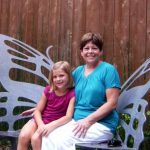 “The first 2 weeks were the hardest. It wasn’t easy to get out there and get going. But once I started walking, I would feel the benefits and that motivated me to continue. Some days, I surprise myself. I’ll get out there for a short walk but then I end up going further then I planned! So to others I would say, “It’s okay to start small.” Just get out and be consistent.“ – Peggy Cole
Food for Thought
The moral of her story is this: You need to build momentum to make a new habit stick. The only way to build momentum is to get out there and go – no matter how slow, how short or how sloppy the result. Simply get out there consistently. Once you’ve done it a few times, you’ll feel motivated to keep going and before you know it you’ve built a habit.
by Lucy | Sep 29, 2016 | Well Balanced Wisdom
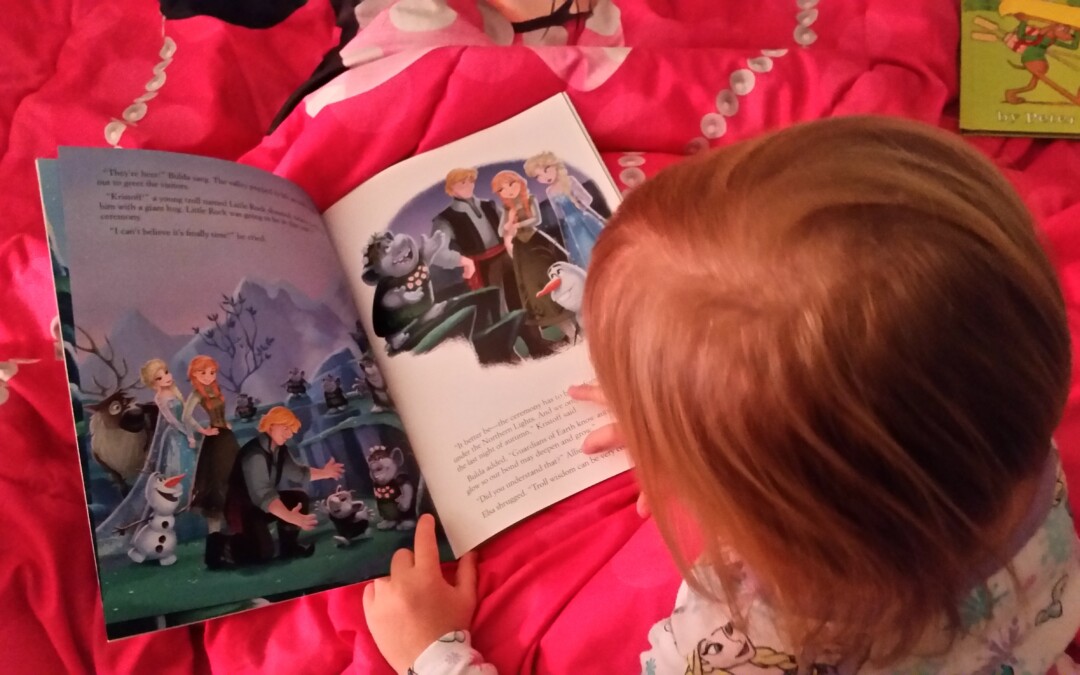
My little one has just discovered the movie Frozen and is now addicted. Every morning on the way to school we listen to one or more of the songs from the soundtrack. You might think that it would get old listening to the same song(s) every day but it’s great, actually. Being able to sing your heart out in the car with your 3-year-old is pretty awesome. You’ve probably heard the iconic song Let It Go even if you’ve never seen the movie. It’s really fun to sing along to and is so catchy that it tends to stick in your head alllll day.
Well, one day this week as I was belting out the tune, part of the lyrics spoke to me in a whole new way.
In the movie, a little girl named Elsa has trouble controlling the magic powers she was born with. She grew up being told to “conceal, don’t feel” because no-one could know of these powers. Every time she thought about them or felt any emotion her powers would get the best of her. One day when they were revealed by accident, she ran away flustered at first but then she decided to embrace them. That’s when she sings…
It’s time to see what I can do
To test the limits and break through
No right, no wrong, no rules for me,
I’m free!
Let it go, let it go… I’m one with the wind and sky….
Now you might be thinking…where is she going with this? Why do I care about Elsa and her powers? And why did she get this song stuck in my head? Hear me out…
Because her family perceived it as a bad thing, Elsa was afraid of her power. The harder she tried to conceal it the more out of control is got.
Here’s how it relates to well-balanced eating: Think of all the foods that you label as bad, especially the ones you feel have a certain power over you. You try to do the “right” thing and stay away from them, but the harder you try the more mental space they take up in your consciousness. It becomes hard to control your thoughts about that food and all you want to do is eat it, so you do. Sometimes, guilt and shame can follow because you weren’t able to hold back.
We all have a tendency to label foods as good or bad. It makes sense. Our brain just wants an easy way of making decisions. We can then say we either did the “right” or “wrong” thing. But it’s not that straight forward. Food is a complex thing that cannot be summed up as simply good or bad. And when we do label them in this way, we give them power over us and we feel out of control.
So if you’ve ever felt this way, it’s time to “let go” of the idea of a perfect diet. “Let go” of labeling your food as good or bad, right or wrong. You’ll gain freedom and control. Then you’ll be singing along with Elsa..
It’s time to see what I can do
To test the limits and break through
No right, no wrong, no rules for me,
I’m free!
Let it go, let it go… I’m one with the wind and sky….
Food for thought: Here are 2 practical suggestions for letting go…
- Mindful eating can help us embrace all foods and receive the feedback we need to make food decisions. We can learn which foods our body enjoys, which ones it doesn’t care for and how much of them we need when we tune into our 5 senses.
- When you hear yourself saying or thinking good, bad, right or wrong, try to replace those adjectives with alternatives like tasty, nutritious, decadent, sweet, colorful, natural, bland, flavorful, comforting, and so on.
What other ways can you think of to let go of the perfect diet?

by Lucy | Sep 22, 2016 | Well Balanced Wisdom
Have you ever felt STUCK? You know, those times when you can’t catch a break, bad things are happening left and right, and it feels like you are just being sucked into quicksand. Maybe it feels like you are surrounded by muck, grime, goo, creepy bugs, hissing snakes, and every other kind of terrible thing. Sometimes life feels like you are stuck in a swamp.
I call it the Shrek syndrome.
You can’t even see what’s a few feet in front of you because your vision is so blurred from the negativity gnats flying around your head. I’ve been there before and I know it’s really easy to stay in that place… stuck and sinking further. I also know that it is possible to dredge your way out. How? Here is what worked for me…
We can’t ignore the stress in our lives but we can change the way we think about it.
When the Shrek syndrome comes on, approach the unpleasantness in a more positive and productive way. It’s not easy but the more you can turn your outlook around the faster you can get out of that nasty swamp.
I was able to stop being an Ogre when I started shining light on the things that hadn’t gone wrong… right down to the air that was filling my lungs. I know it may sound cheesy but it’s a PROVEN STRATGEY. Positive thinking has been linked to an increased life span, lower rates of depression, lower levels of distress and even greater resistance to the common cold.
Your homework: Choose at least one to try this week.
PRACTICAL WAYS TO SHINE LIGHT ON THE GOOD AND GET OUT OF THE SWAMP
Gratitude journal – daily, weekly or whatever – simply jot down the things for which you are thankful. Think… what if you woke up today with only the things you expressed gratitude for yesterday?
Positive Self Talk – We often say things about ourselves that we would never say to others. STOP DOING THAT! Place a positive affirmation somewhere that prompts you to read it out loud every day. My favorite? You are enough. And at the end of the day: You did enough. You deserve rest.
Keep a monthly log of accomplishments and hard efforts. Try a new vegetable? Jot it down! Meditate in a difficult situation. It goes in the log too! If you tried hard at something, regardless of whether you fully succeeded or not, that’s important. Both successes and efforts get credit here.
Change your perspective: Instead of saying, I’ve never done this before,” say “It’s an opportunity to learn something new.” Instead of saying, “It’s too complicated,” say “I’ll try from a different angle.”
What do you do to shake the Shrek syndrome??